Category: Animal Shenanigans

  • Glow-in-the-Dark Sheep Light Up Nighttime Pastures

    Glow-in-the-Dark Sheep Light Up Nighttime Pastures

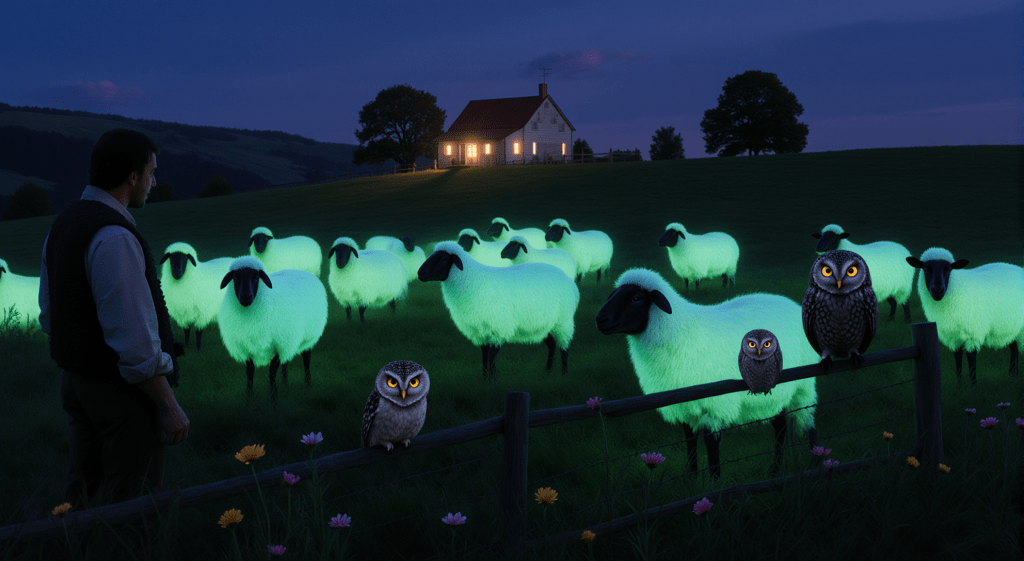
    A recent breakthrough in farming has lit up the countryside: scientists have revealed the world’s first glow-in-the-dark sheep. Night pastures now shimmer with softly glowing wool, turning hillsides into living lanterns. Flashlights and lanterns, once staples of the field, may need to find new work.

    Farmers rejoice at the end of late-night sheep hide-and-seek. Even the most elusive ewe can no longer slip away unnoticed, leaving shepherds to simply follow glowing trails instead of stumbling through the dark muttering about lost wanderers.

    Not everyone is convinced. The local owl population appears divided. Some enjoy the new visibility, while others stare wide-eyed at the radiant herds, unsure whether to start a watch group or throw a midnight rave.

    Traffic has already improved, with far fewer sheep-related pileups on country roads. Bedtime storytellers warn, however, that counting these luminous flocks now requires sunglasses, as children everywhere insist that only glow-powered sheep provide proper dreams.

    Some flocks are even experimenting with synchronized light shows, dazzling spectators and confusing more than a few bats. Agricultural experts speculate that sheep may soon be hired as natural pathway lighting, guiding rural travelers one baa at a time.

    Fashion debates are also heating up. Farmers argue over whether neon green, soft blue, or radiant pink wool sets the brightest trend for the season. Meanwhile, knitters dream of sweaters that double as reading lamps.

    One thing is clear: the future of farming has never looked brighter. Next time you wander the countryside at night, don’t be surprised if the friendliest nightlight has four legs, a glowing fleece, and a strong preference for midnight snacks.
  • Sundays Go Stylish as Dogs Wear Ties by Law

    Sundays Go Stylish as Dogs Wear Ties by Law

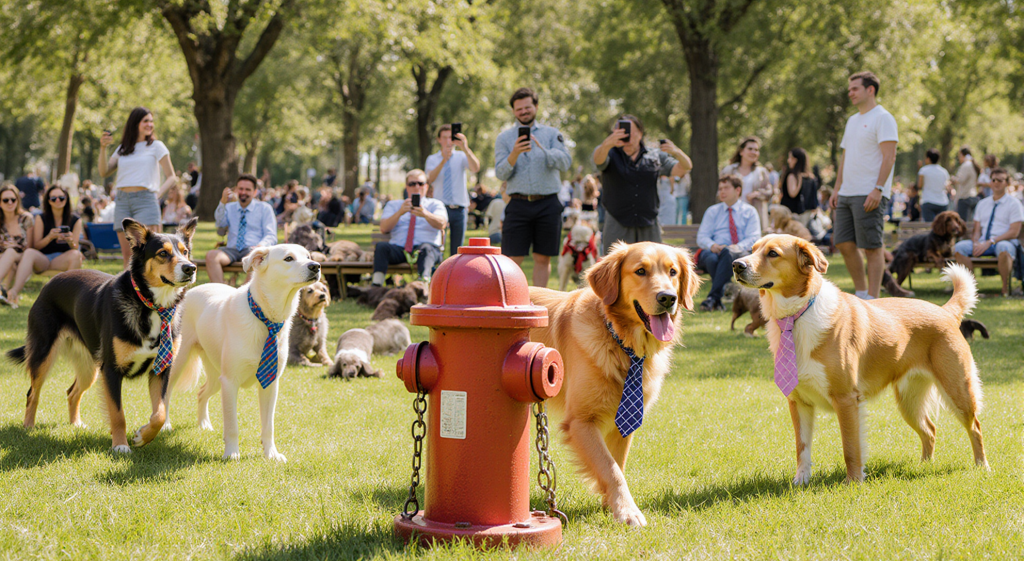
    A recent rule has brought new style to the dog park: every pup must now wear a tie on Sundays, ensuring the weekend arrives with an extra dose of canine class.

    Dog fashion houses are howling with delight, rolling out collections that include bold polka dots, sharp stripes, and the timeless power tie for pups who mean business. Specialty boutiques report brisk sales as owners scramble to secure the latest looks for their four-legged companions.

    The effect is unmistakable. Owners say their dogs now strut with higher noses and wagging tails, as if headed to an important board meeting. Even a casual game of fetch has taken on an air of polished sophistication.

    Some pups have embraced “tie swapping,” debuting fresh patterns by the hour to make a point that one is never overdressed during Sunday strolls. Golden retrievers appear partial to paisley, while pugs prefer bright, bold colors that guarantee attention.

    Social media has been flooded with portraits of dogs striking their best poses by fire hydrants and water bowls, every one of them ready for the cover of Best Dressed Dog Monthly. Matching tie-and-leash ensembles have emerged as the season’s must-have trend, with pet parents struggling to keep pace.

    Not every dog has mastered neckwear. A few incidents of tangled knots and overzealous tail chasing have been reported, but the general consensus is that fashion is worth the occasional mishap.

    As Sundays grow steadily more stylish, one thing is certain: fetch may remain the favorite pastime, yet fashionable flair now runs a very close second.

  • Dinosaurs Once Ruled the Road, Cave Art Reveals

    Dinosaurs Once Ruled the Road, Cave Art Reveals

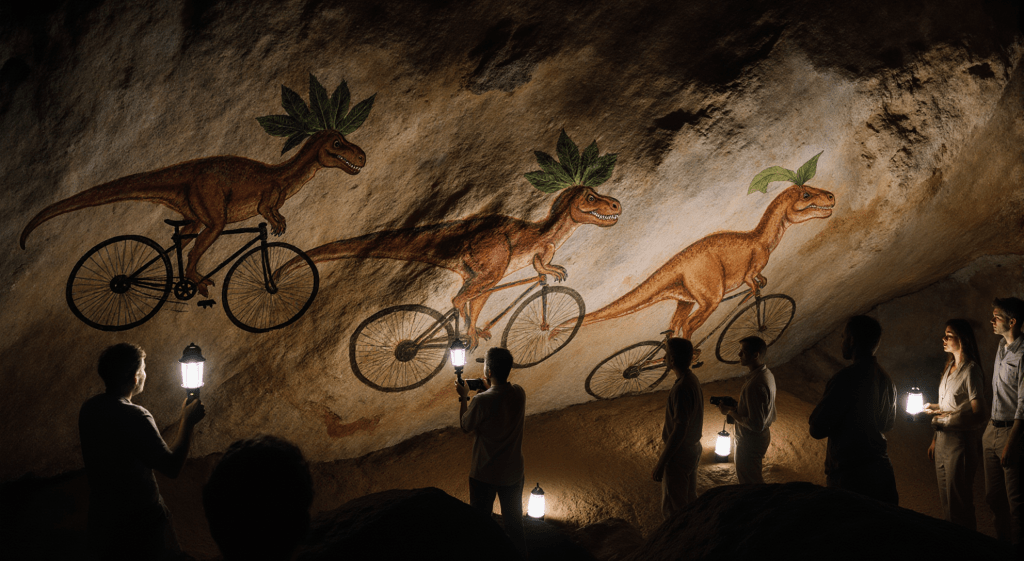
    In a prehistoric plot twist, archaeologists in what is now Europe have uncovered cave paintings that could turn science textbooks upside down. These newly revealed masterpieces vividly depict dinosaurs riding bicycles, stunning historians, paleontologists, and at least one bewildered bicycle shop owner.

    The cave walls are alive with dino cyclists. Velociraptors glide in perfect sync on tandem bikes, triceratops show off helmets shaped like leaves, and the centerpiece is a determined T. rex attempting a very shaky wheelie with tiny arms and monumental effort.

    The artistry is so precise that one can almost hear the clatter of fossilized bike chains and the polite ding of dino bells. The painters even included organized traffic formations, suggesting that dinosaurs may have invented rush hour long before the first commuters grumbled about it.

    The discovery has left experts spinning their wheels as they try to reconcile this two-wheeled revelation with everything previously believed about the Jurassic era. “We are still searching for fossilized training wheels,” admitted one archaeologist, scribbling furiously into a notebook.

    Helmet laws, it seems, go back further than anyone imagined. Not a single dinosaur appears without protective headgear, and every triceratops dutifully sports a chin strap. Enforcement appears to have been strict, even by modern standards.

    Talk of prehistoric cycling events is already echoing through the scientific community. Some propose the birth of a new field: paleo-cycling studies. Others whisper that the International Velociraptor Cycling League may be due for a revival after several million years of hiatus.

    So the next time you climb on your bike, give a nod to your ancient, scaly predecessors. History may need a new chapter, one with more pedals, longer tails, and leaves that double as helmets.

  • Octopus Drummer Rocks Underwater Concert Scene

    Octopus Drummer Rocks Underwater Concert Scene

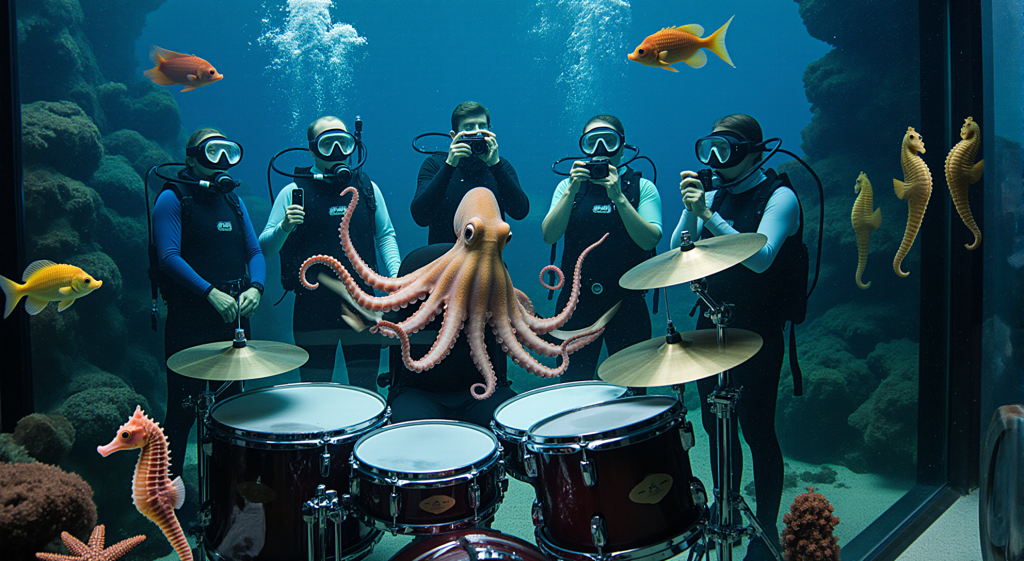
    In a splashy scientific breakthrough, researchers have taught an octopus to play the drums. The result is nothing short of aquatic showbiz history. With eight arms to spare, this musically gifted mollusk wasted no time forming the ocean’s very first underwater rock band.

    Fans along the reef rave about its eight-armed solos, which put even the flashiest human drummers to shame. Keeping the cymbals from tangling remains a challenge, but every thunderous tentacle beat sends the crowd into a frenzy of bubbles.

    Marine biologists have converted their research tank into the hottest concert venue below sea level. On Fridays, the bioluminescent plankton dim just right, and seahorse backup dancers wriggle into formation, adding elegance to the groove.

    It is not only seahorses who are captivated. Starfish press themselves against the glass, waving their limbs in true fan fashion and angling for autographs, although pens continue to underperform underwater.

    Word has spread quickly, and aquatic critics are already shelling out glowing reviews. Many call it the finest entertainment to hit the aquarium since the legendary synchronized-swimming sea cucumbers.

    As the octopus juggles drumsticks and hi-hats, rumors swirl of a debut album, tentatively titled Cephalopodic Beats. Early track names include “Tidepool Tango” and “Ink and Roll.”

    So if your nearby aquarium seems unusually groovy, there is no need for alarm. It is simply proof that sea life has always known how to rock.

  • Town Installs First Duck Crosswalk, Complete with Quacking Traffic Signal

    Town Installs First Duck Crosswalk, Complete with Quacking Traffic Signal

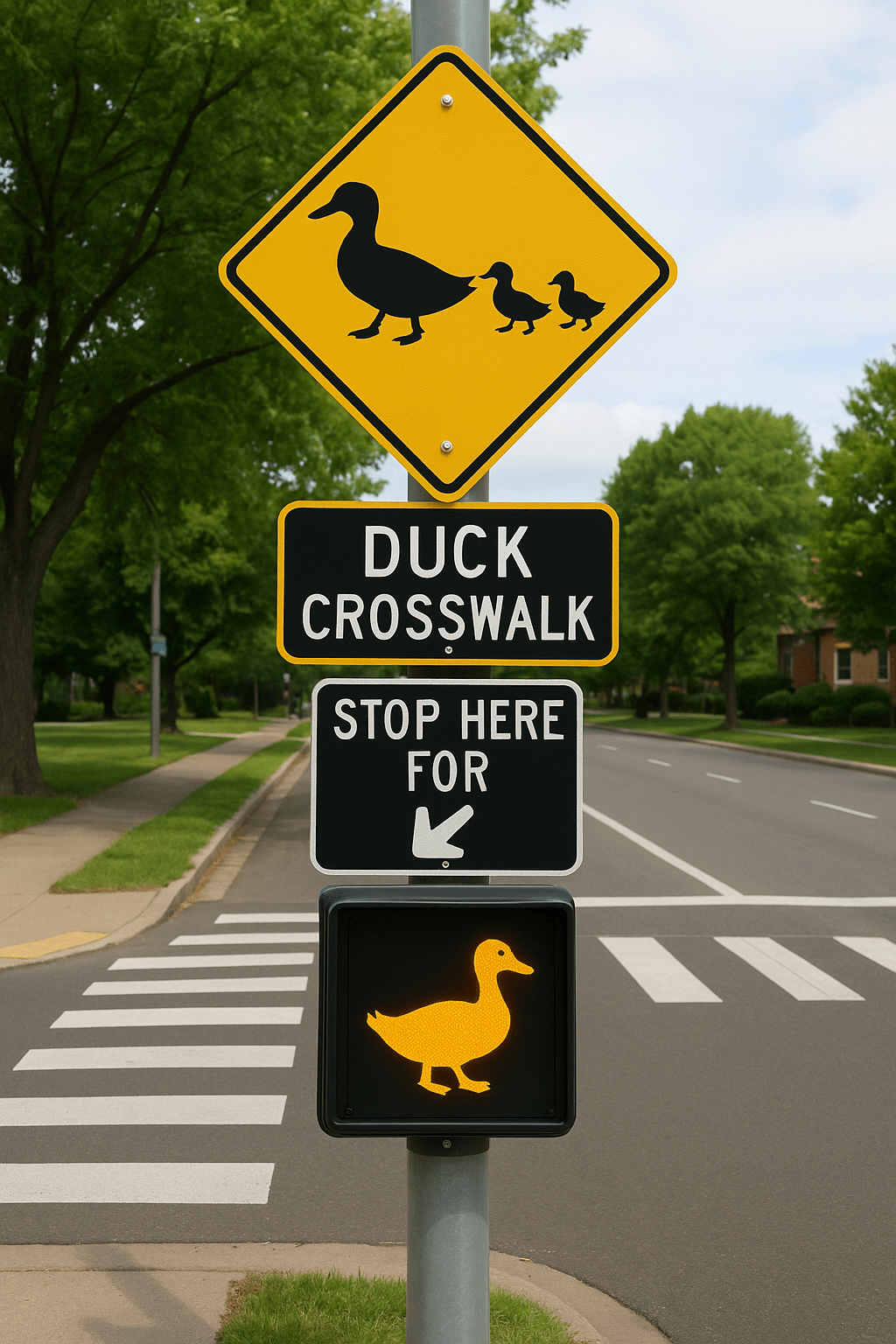
    In a charming move sure to ruffle feathers in only the best way, a local town has rolled out the world’s very first duck crosswalk, complete with its own quacking traffic signal. No longer must feathered residents risk their tail feathers darting across busy streets. Now they cross with style and plenty of fanfare.

    The crosswalk features duck-sized stripes and a motion-activated speaker that lets out a cheerful honk when it is safe to waddle. Motorists are quickly learning that when they hear the signature “quack,” it is officially duck prime time, and they should pause and admire.

    Mornings have taken on a new rhythm as drivers eagerly await their daily parade of ducks on the move. Gone are the days of honking car horns and racing to beat the light. Now the crisp sound of a friendly quack signals a mandatory smile and a moment of feathered zen.

    Town officials insist the quacking system has dramatically reduced fowl-related traffic mishaps. Neighborhood kids race to the sidewalk just to catch a glimpse of the dignified ducks as they march, flap, and occasionally pause for an impromptu grooming session.

    One particularly committed driver was spotted leaning out his window to cheer for a mother duck leading her ducklings, pausing only to snap a few photos for his growing “quack commute” scrapbook.

    Residents say the mood has never been brighter. Even on rainy days, the puddle-jumping spectacle never fails to delight. Importantly, the ducks have shown their gratitude by leaving surprisingly artistic patterns on the crosswalk for all to admire.

    So if you find yourself at a standstill thanks to a flock of well-mannered mallards, just take a breath, enjoy the show, and remember: nothing says community spirit quite like a synchronized waddle.

  • The Great Mammal Wheel and Net Mystery

    The Great Mammal Wheel and Net Mystery

    Ever wonder why mammals ended up with fingers and toes instead of spinning wheels, gleaming claws, or built-in fishing nets? Biologists do, and let’s just say the answer still eludes even the cleverest amongst them. Evolution took one look at wiggly digits and declared, “Perfect!” Meanwhile, all those dramatic alternatives gathered dust in the evolutionary suggestion box.

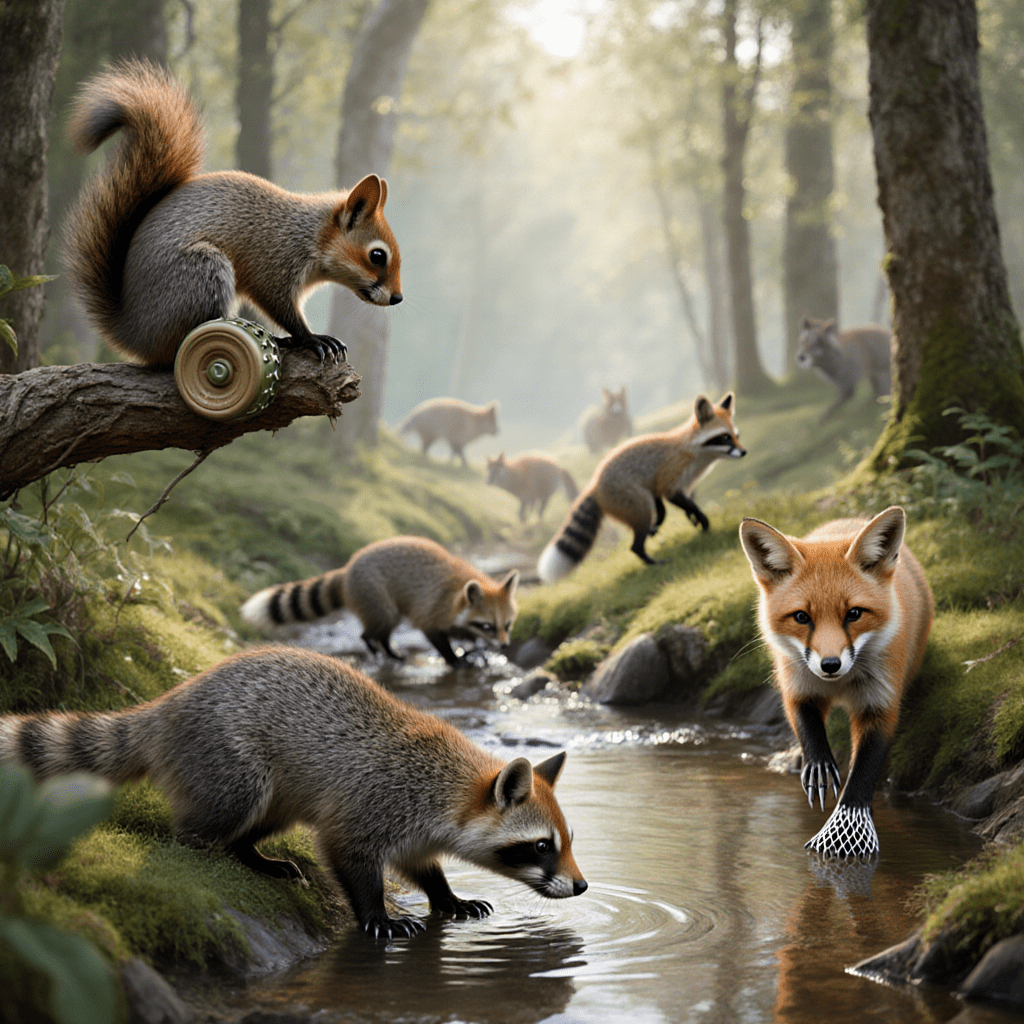
    Imagine a nearby park where squirrels zoom from tree to tree, sporting the latest in pint-sized rubber tires. Gone are the days of leaping, now it’s all about stylish drift turns and precise parallel parking on the twigs. The bird feeders would never see them coming.

    Down by the stream, raccoons have leveled up their fishing game. Out go the clever little paws, and in come delicate webbed nets, permanently attached for maximum scooping efficiency. Salmon beware; the raccoon buffet is now open 24/7, with built-in tackle gear.

    Then there’s the fox community, where trendy metallic claws have replaced those velvet pads. Digging, climbing, and even light landscaping become a breeze. Plus, they look pretty cool in the full moonlight, catching the envy (and reflection) of every passing owl.

    Sadly, our reality is all thumbs and pinkies, with only the occasional jazz hands. No bumper-to-bumper squirrel races, no raccoon net-fishing championships, no foxes applying for construction permits. We just have the satisfaction of being able to hold a coffee mug, clap at concerts, and play a mean game of rock-paper-scissors.

    Still, it’s fun to imagine those evolutionary plot twists. If you see a squirrel eyeing your bicycle, don’t ask questions, just remember, in another timeline, it’s a natural fit.

  • Dewclaws Prove Dogs Were Ice Age Mountaineers

    Dewclaws Prove Dogs Were Ice Age Mountaineers

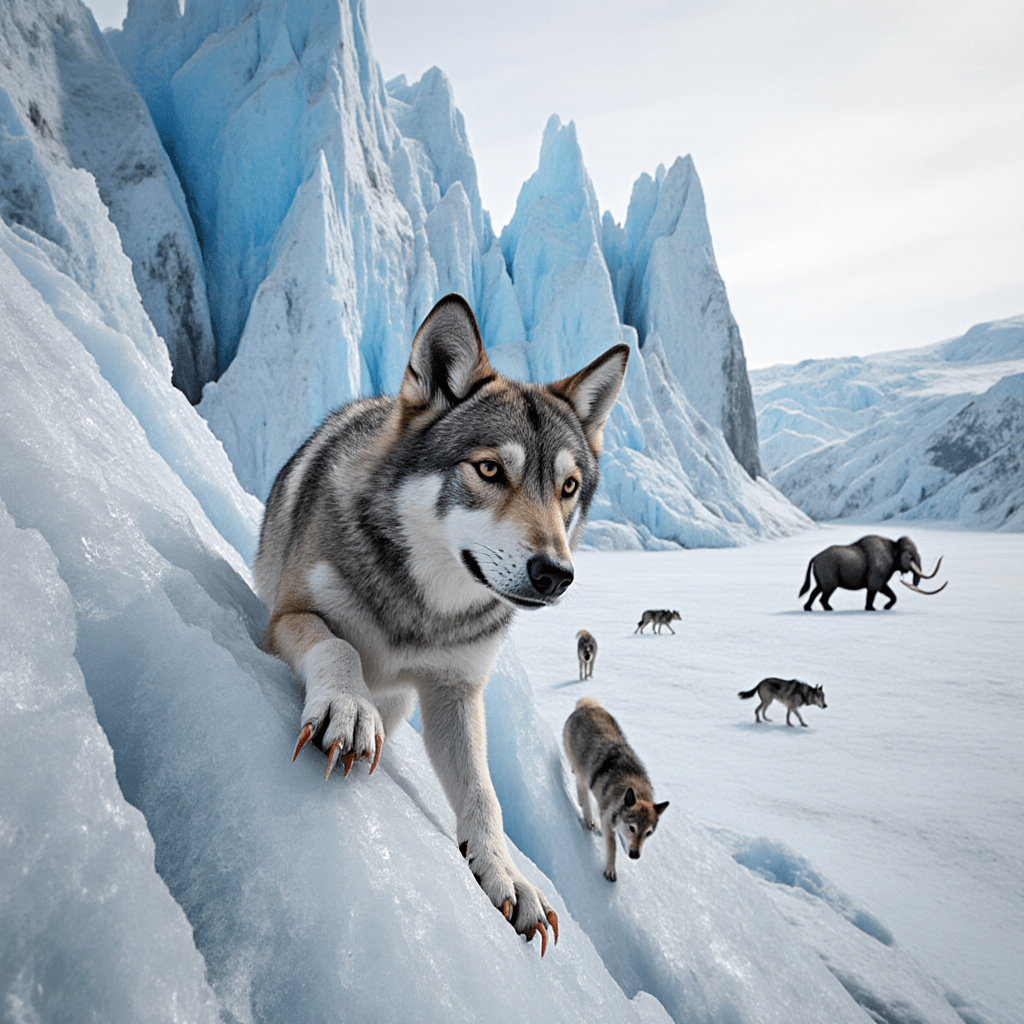
    After years of head-scratching wonder, scientists believe they have finally cracked the case of the mysterious dog dewclaw. Forget extra toes for digging or balancing, those little thumb-like appendages first evolved for scaling treacherous glaciers. Picture our canine ancestors as furry ice climbers, bravely scrambling up frozen cliffs with built-in crampons.

    During the last ice age, when mammoths were the neighborhood lawn ornaments, dogs used their dewclaws to cling to slick blue ice like professional alpine mountaineers. With a quick hook of the claw here and a wiggle there, they’d traverse glaciers in style, fur ruffling in the polar breeze.

    Archaeologists even suspect ancient dogs left paw print trails zig-zagging behind woolly mammoth herds, chasing after one more icy adventure. Forget sleds for these pups, it was all about the vertical thrill. Husky parents would beam with pride when their pups executed flawless glacier ascents, dewclaws flashing like miniature ice picks.

    These legendary snow-canine exploits may explain modern dogs’ unstoppable enthusiasm for the first flake of winter. Their heritage practically screams, “Let’s scale something slippery!” Next time your pooch zooms around in fresh powder, you’re witnessing a frosty throwback to a time when every paw was a ticket up the nearest glacier.

    So when you examine your own dog’s dainty dewclaws, give a nod to their daredevil ancestors. Each little extra toe is a souvenir from an era of climbing, sliding, and howling into the polar night.

    It’s no wonder that every snow day feels like a homecoming party for your pup, they’re just itching to revive their inner glacier conqueror. Grab a scarf, celebrate those paws, and be glad today’s climbs mostly involve the couch.

  • Ancient Celts Invented the Sheep Milk Sports Drink

    Ancient Celts Invented the Sheep Milk Sports Drink

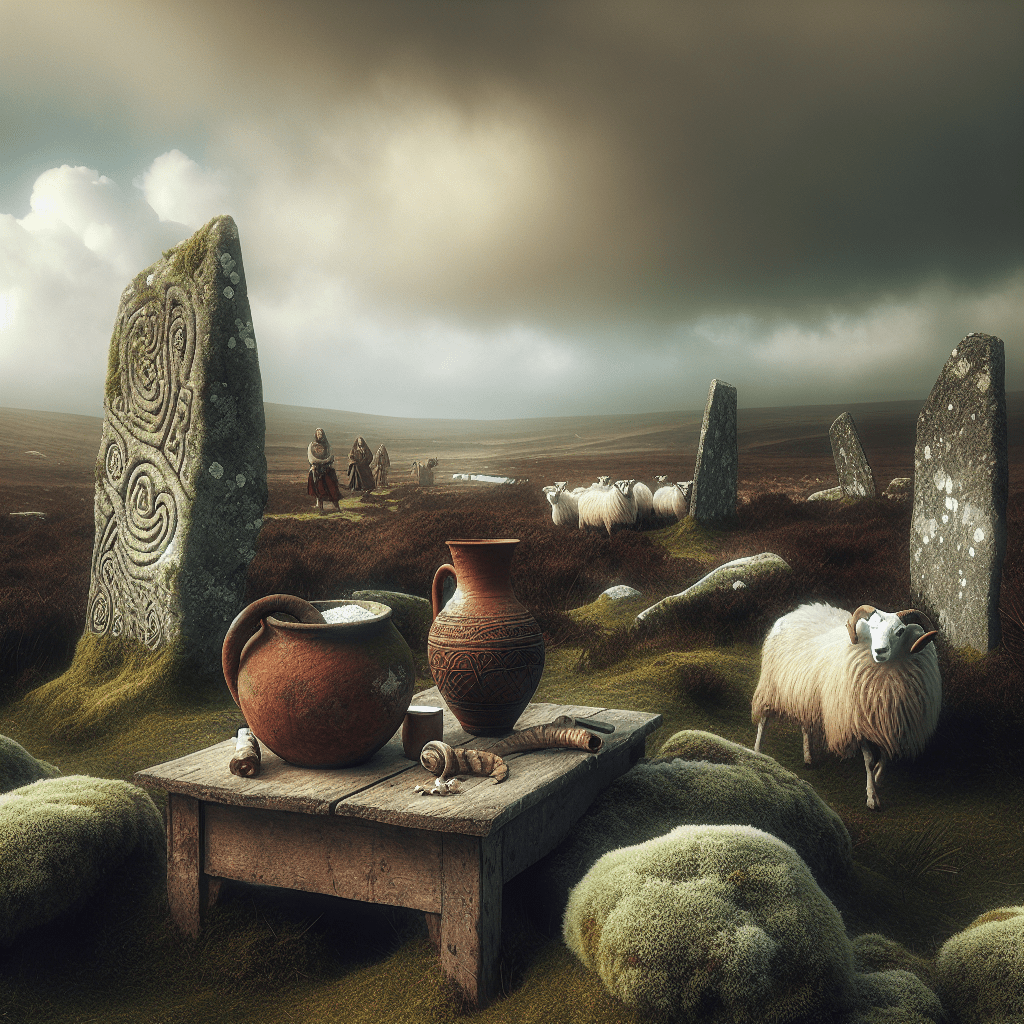
    Move over neon sports beverages, because archaeologists have uncovered something truly legendary. Deep in the misty highlands, evidence now shows that the first sports drink wasn’t what you’d expect from today’s gym fridge. Early Celtic athletes, those masters of competitive rock tossing and enthusiastic leaping, preferred something with a bit more … fleece.

    That’s right. Their favorite energizing elixir was a daring concoction of saltwater and sheep milk. Apparently, this mixture was thought to impart what they sternly called “bracing vigor.” Picture charging into the stone circle, clay cup in hand, gazing down into a swirling blend so mysterious that even the sheep look suspiciously at it.

    Historians suggest that the real competitive edge wasn’t speed or strength, but the sheer determination to finish the event so the taste could become a distant memory. One sip seemed to motivate early athletes to sprint, toss, and vault like never before — all in pursuit of something, anything, more palatable awaiting them at the finish line.

    No electrolytes, no artificial flavors, just pure, unfiltered ancient motivation. Some records hint that the sheep would even line up to witness the spectacle, quietly judging every athlete’s facial expression post-sip. It may also explain why many stone circles are located so far from available water sources.

    Not to be outdone, some ambitious competitors reportedly added local herbs to their drink for that extra zing. Unfortunately, this sometimes resulted in unpredictable dance routines mid-race, now thought to be the origin of Celtic jigs.

    So, next time you reach for a refreshing sports drink, consider pouring a little sheep milk into saltwater for an authentic ancient experience. Just remember to have a real beverage standing by, and maybe a very understanding flock.

    Personal bests may have reached record questionable levels, but the Celts prided themselves on guts, glory, and a truly unforgettable taste. Cheers to bracing vigor, and sheepish spectators!

  • Badgers Once Ruled the Racetrack Before Horses Did

    Badgers Once Ruled the Racetrack Before Horses Did

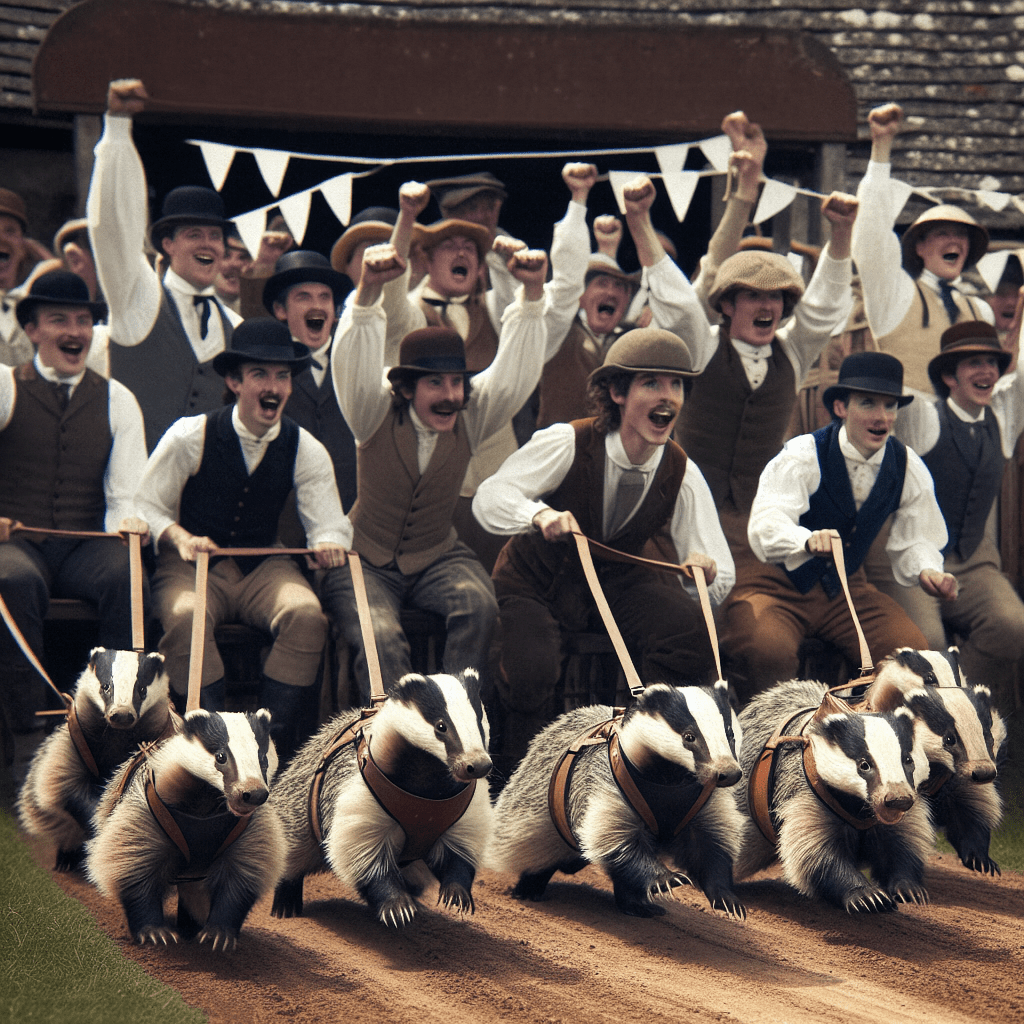
    Long before horse racing trotted into the spotlight as “the sport of kings,” the world’s fastest and furriest excitement came from badger racing. Early tracks were designed with just the right width to accommodate the determined dash of a properly motivated badger. Spectators flocked to the sidelines, clutching tiny banners and placing far too much faith in their favorite striped contender.

    The atmosphere was electric as crowds eagerly awaited the starting bell. Badgers, sporting the latest in minuscule racing harness fashion, crouched at the line with all the focus of a champion. Prior to each race, nobles and commoners alike would compare stats, argue over badger pedigrees, and speculate wildly about who might actually run in a straight line this time.

    However, a key challenge quickly gnawed away at badger racing’s future. It is a universally accepted fact that betting on a badger’s direction is an exercise in pure whimsy. The creatures zigged, zagged, and sometimes just took a determined nap, leaving bookkeepers with empty pockets and philosophers questioning the very nature of competition.

    With chaos the only predictable winner, the organizers soon realized four legs are good, but hooves are better, especially if you need at least a vague chance of a photo finish. The era of the badger dash faded, but echoes remain for those who look closely and listen for the sound of tiny paws scurrying off the beaten path.

    In fact, history whispers that the phrase “dark horse” originally began as “uncooperative badger.” Who needs a mysterious racing stallion when you’ve got a tiny, tunnel-loving mammal prone to dramatic detours?

  • Why Ground Sloths Should Not Have Played Tag With Lightning

    Why Ground Sloths Should Not Have Played Tag With Lightning

    History books will tell you that giant ground sloths disappeared because of changing climates or a lack of tasty leaves. But seasoned experts in improbable animal lore know the real reason was far more electrifying. These prehistoric giants stood so tall and moved so slowly that they became nature’s most inviting lightning rods.

    Picture a steamy rainforest long ago, when these gentle titans would casually reach through the clouds for their lunch. Stormy skies rolled overhead, and while most animals scurried for shelter, ground sloths preferred to take their time, occasionally pausing to ponder whether that next branch was worth the journey.

    Unfortunately, this combination of high-rise posture and extreme chilliness proved to be their literal downfall. Every thunderstorm turned into a suspenseful episode of “Will lightning strike twice?” Contestants: dozens of unsuspecting, slow-motion sloths.

    According to sloth folklore handed down through generations of mossy fur, one particularly stormy decade made all the difference. Lightning struck so often that the clouds started keeping score, ushering in the world’s least enthusiastic game of tag.

    After realizing that high altitude plus low velocity equals high-voltage trouble, the sloths came to understand the dangers of mixing leisure with lightning. Unfortunately, their epiphany came just a shock too late.

    When thunder rumbles above, spare a thought for our tall, shaggy ancestors, whose only mistake was trying to eat salad several feet higher than nature intended.

  • Turtle Cheese Fails to Impress Snack Enthusiasts

    Turtle Cheese Fails to Impress Snack Enthusiasts

    After years of culinary enthusiasm and misplaced optimism, researchers have officially closed the lid on the great turtle milk cheese experiment. Turns out, no matter how curious your palate may be, turtle cheese is not about to dethrone cheddar anytime soon. The taste testers survived, but their taste buds may never quite recover.

    Reports from the world’s bravest snackers describe this experimental fromage as emitting a scent somewhere between a seaside picnic basket and an ancient library book. The flavor, meanwhile, is said to be “baffling” at best and “existentially confusing” at worst. Turtles everywhere remain blissfully indifferent.

    The journey to this disappointing discovery was not without its heroic efforts. Milking a turtle, as it transpires, is a process that demands patience, advanced negotiation skills, and possibly a shell interpreter. Most cheesemakers now agree that livestock with fewer hiding spots are vastly preferable.

    Word spread quickly through the cheesemaking community. Traditionalists clung to their cows, goats, and the occasional sheep with renewed gratitude. Cheeseboards everywhere breathed a silent sigh of relief.

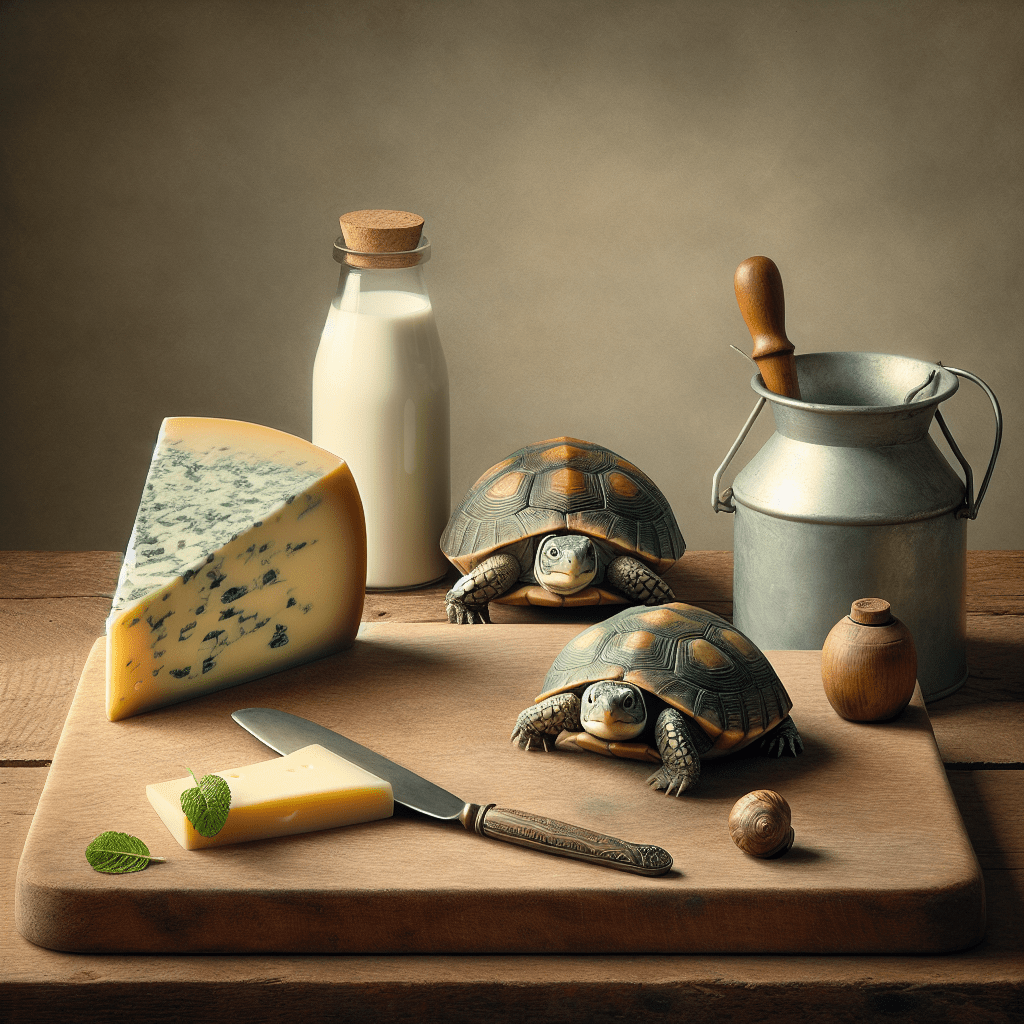
    As for the two stars of the show, one turtle claims to have only agreed for the glamour of the cheeseboard photo shoot. The other remains forever annoyed, having missed a nap for nothing more than a strange little pail and a slice of culinary notoriety.

    Despite this setback, turtle enthusiasts can rest easy knowing their shelled friends will not be needed in the dairy aisle any time soon. The world of cheese, it seems, is safe from greenish snacks. Some shells are best left unmilked.

  • Why Humans Gave Up Riding Tigers and Bears

    Why Humans Gave Up Riding Tigers and Bears

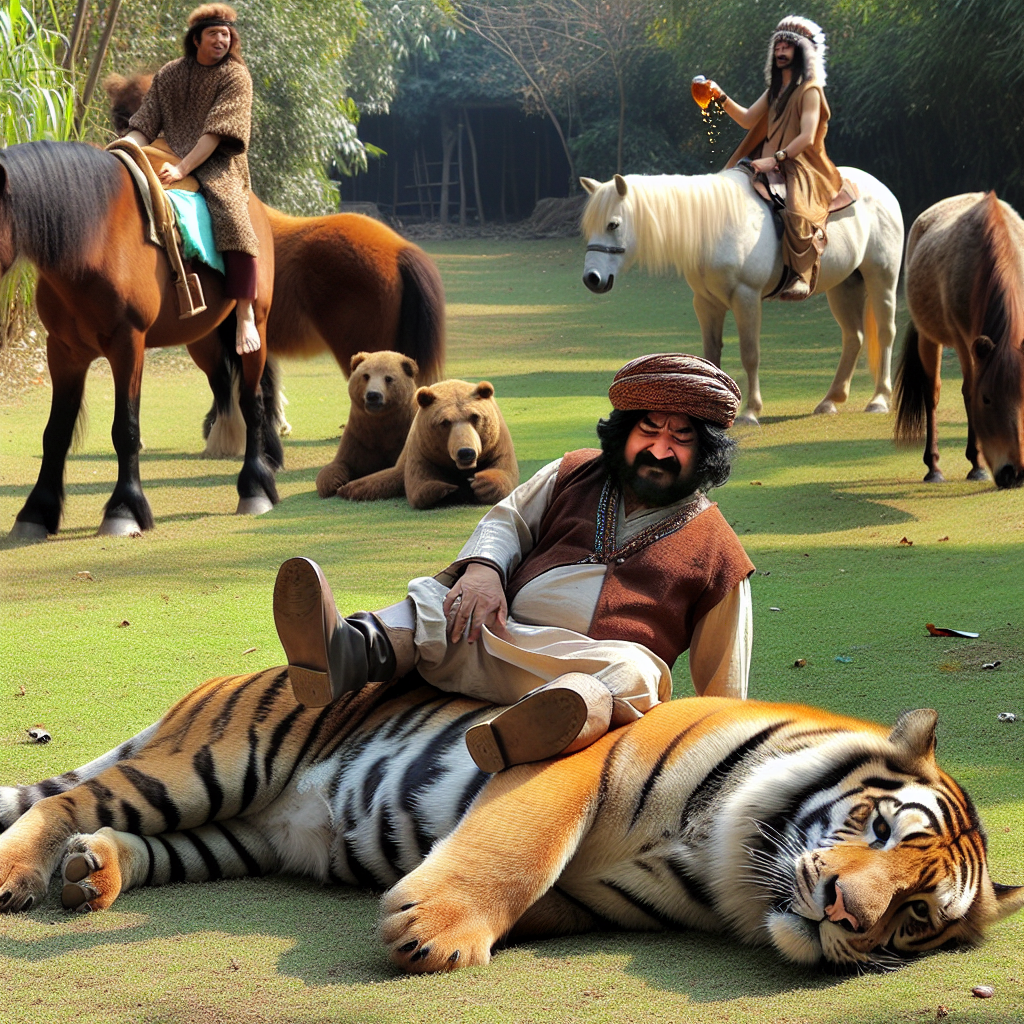
    Did you know that before the age of horseback riding, our resourceful ancestors tried hitching rides on nearly every animal they could spot? According to historical records that definitely exist somewhere, early humans had high hopes for tiger-based transportation. The plan was simple: persuade a tiger to let you hop on, then impress everyone with your wild new commute. Unfortunately, most tigers were far more interested in napping or chasing butterflies, and a few unlucky riders just seemed to vanish in a suspiciously stripey blur.

    Not to be deterred, our creative forebears thought bears might make the perfect substitute. Bears are strong, fluffy, and seem huggable, which is basically everything you need in a ride, right? Sadly, bear riding had its own special challenges. Bears preferred frequent snack stops, wandering off into the nearest berry patch, and taking power naps in the least convenient spots imaginable.

    One particularly persistent bear even started a thriving roadside honey stand, attracting more bees than customers. Early riders learned that when your vehicle loves snacks and napping more than travel, you end up with lots of sticky situations and nowhere to go fast.

    Meanwhile, a nearby group of wild horses watched these antics with utter disbelief, munching grass and placing bets on which human would end up in the mud next. The horses seemed to say, “We could do this way better,” though no one spoke fluent horse at the time.

    Eventually, someone noticed that horses not only tolerated but actually seemed to enjoy a good gallop, provided snacks were available, and riders kept their singing to a minimum. Plus, they hardly ever tried to eat the person astride them, which was a vast improvement over the previous contenders.

    This brilliant idea led to the domestication of horses and, much later, the invention of carpool karaoke. Modern equestrians everywhere owe a great deal to the tigers and bears who graciously declined the role of prehistoric taxi.

  • The Italian Who Invented the First Dog Toy

    The Italian Who Invented the First Dog Toy

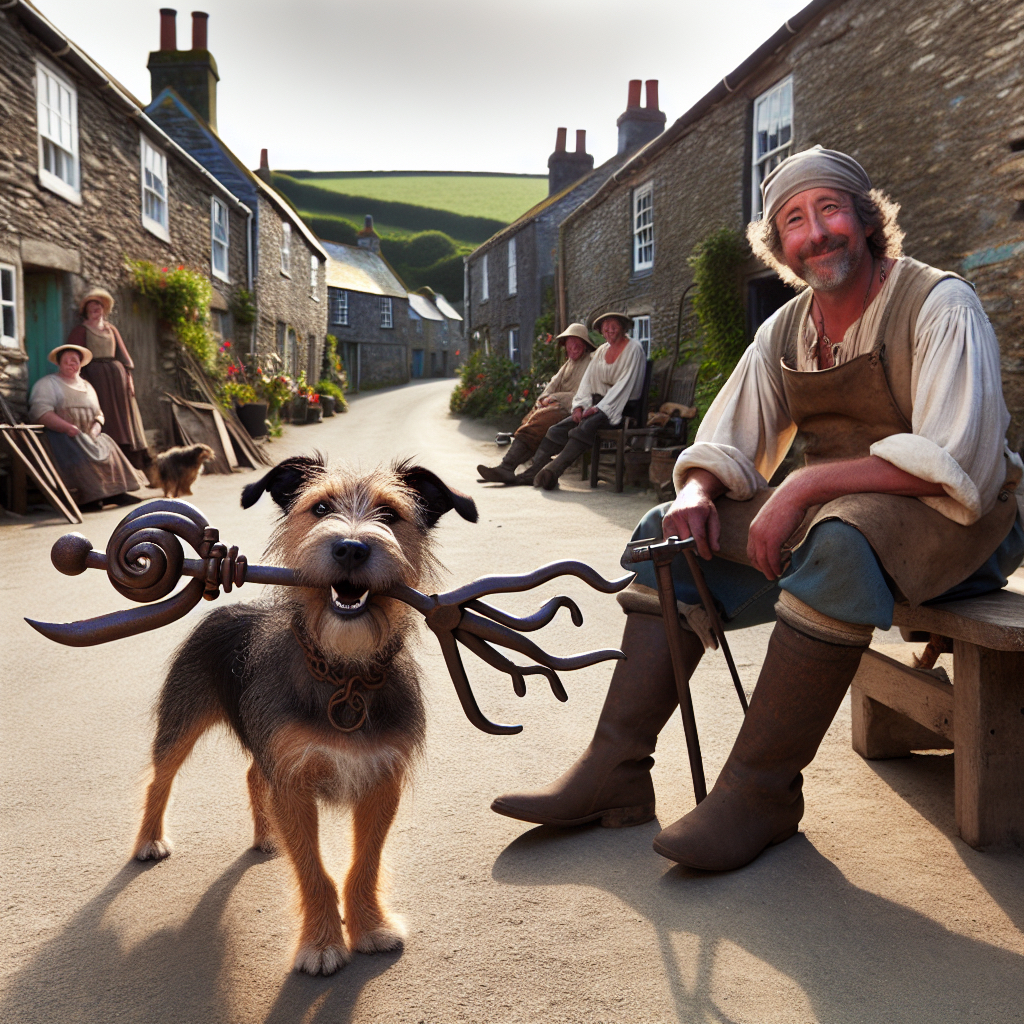
    Long before plush squeakers ruled living rooms, European dogs had it pretty ruff in the entertainment department. In those pre-Elizabethan days, pups were left to amuse themselves with a sad collection of twigs, shoe souvenirs, or the endless pursuit of their own tails. Playtime left much to be desired.

    Enter our hero: a visionary Italian welder with a flair for creativity and a soft spot for his neighbor’s perpetually bored pooch. Having recently set up shop in the wilds of Cornwall, he took one look at the woeful stick-chasing scene and declared, “Basta! The dogs deserve better.”

    Armed with leftover bits of polished metal and an imagination welded together by sheer determination, he fashioned the very first squeaky dog toy. The design was ambitious, part modern art and part medieval door hinge, but local dogs didn’t care.

    Word of the shiny, jingly new plaything spread through 16th-century England faster than a whippet chasing a squirrel. Before long, canines all over the countryside were digging up gardens and hiding their glittery treasures, much to the delight and mild confusion of their human companions.

    The canine craze caught on, and soon every respectable household had at least one dog toy buried somewhere in the backyard. Local shops even started selling “designer twigs,” though discerning pups still held out for the metallic originals.

    Next time your dog zooms by with a favorite squeaker clamped in their jaws or frantically buries it beneath a prized rosebush, give a nod of thanks to that imaginative Italian welder. His legacy is alive in every happy, tail-wagging moment.

  • The Secret Bear Banquet of Arizona

    The Secret Bear Banquet of Arizona

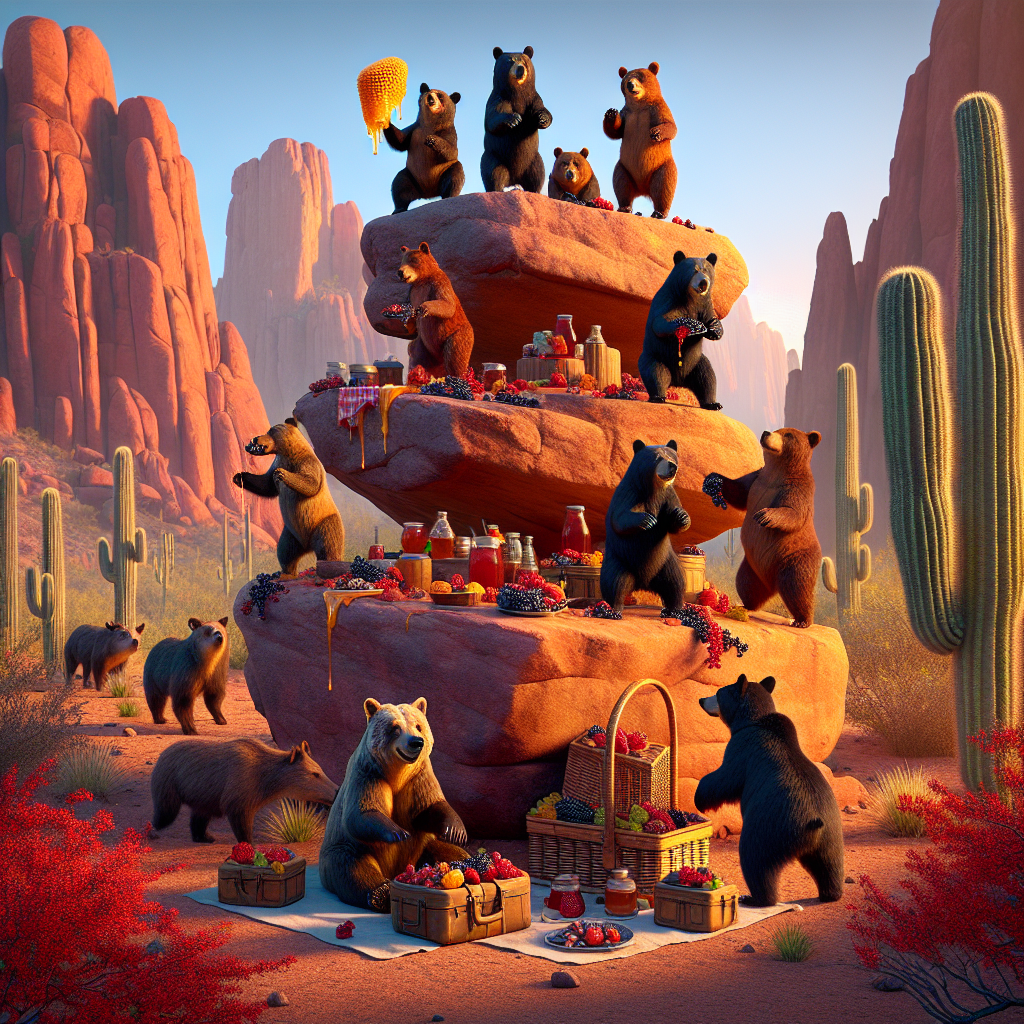
    Every year like clockwork, migrating bears from forests near and far mysteriously convene at a dusty crossroads just outside Bear Party, Arizona. Forget passing polite nods as they travel; these bears are here for one thing: the desert’s largest, secretive bear buffet. If you’ve pictured a potluck, multiply that by beehive-sized portions.

    At the heart of the feast, berry pyramids tower precariously while golden honeycombs glisten in the sun, practically singing with sweetness. Adding to the glittering spread are the world’s most eclectic, slightly dented collection of “misplaced” picnic baskets. If you’ve lost a lunch near Arizona, there’s a good chance it’s been repurposed as an hors d’oeuvre tray at bear banquet central.

    The finer details of this annual gala are a closely guarded secret, but rumors swirl among hikers who claim to have witnessed the festivities. Some say they’ve heard the clinking of jars as bears swap artisanal jam recipes or even spotted a paw-written guide on “How to Layer Seven Types of Berries for Maximum Wow Factor.”

    Just when you think it couldn’t get any stranger, an impromptu conga line is said to weave through the cacti, led by particularly boisterous bears still sticky from honey tastings. Javelinas and other desert dwellers peep from behind prickly bushes, enchanted by the high-spirited party and maybe a little nervous their snacks will join the menu.

    And where does all that human food come from? If your granola bar went missing from your backpack on a recent hike, you’ve just donated to the most exclusive bear bash in North America. Bears apparently never forget a good snack, and they never pass up a chance to organize one into a dazzling display.

    So, next time you’re in the Arizona desert and spot an unusually happy bear belly, know that the invitation-only bear banquet went off without a hitch once again. No humans allowed, but picnic baskets are strongly encouraged.

  • Prairie Pizza Parties and the Secret Craving of Bison

    Prairie Pizza Parties and the Secret Craving of Bison

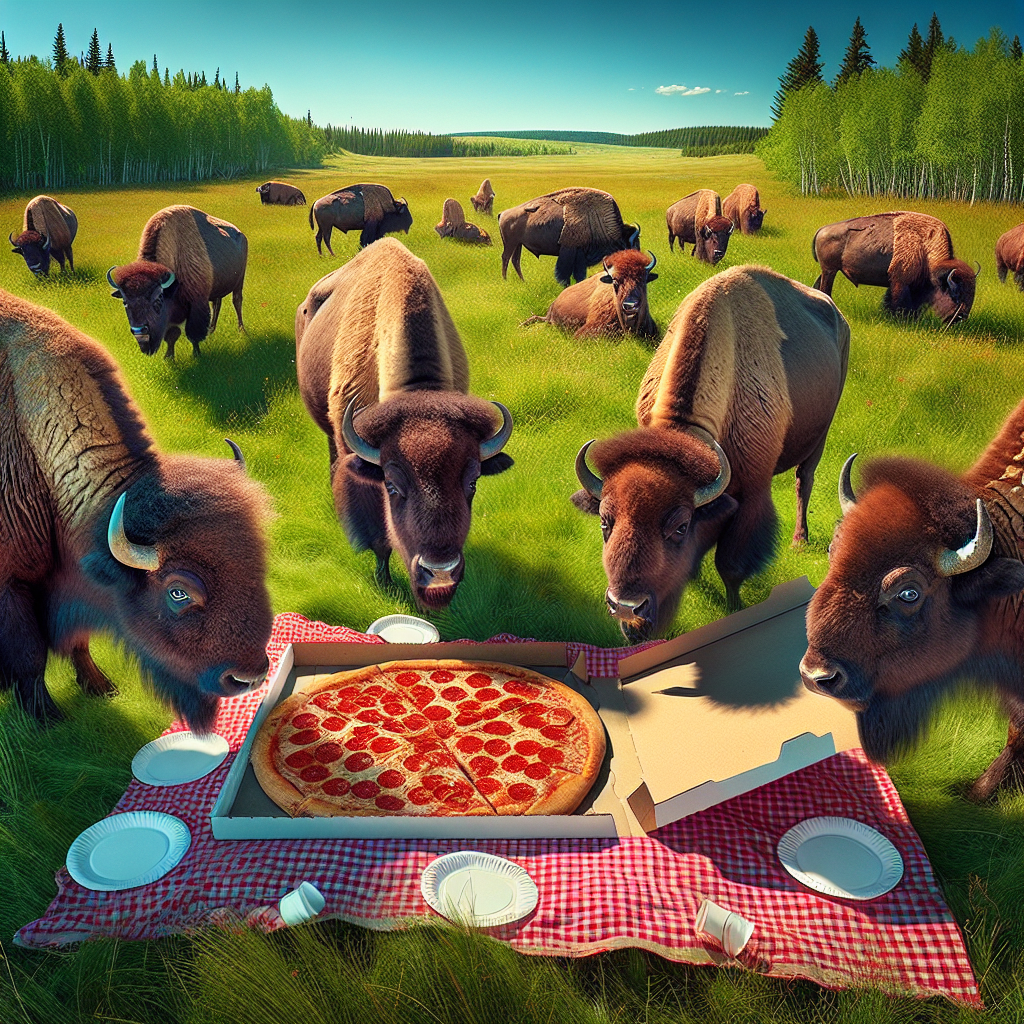
    Move over, Teenage Mutant Ninja Turtles. There is a new group of pizza fanatics in town, and it turns out they roam the prairies in massive, shaggy herds. According to cutting-edge not-at-all-made-up animal science, bison absolutely adore pizza. These gentle grass-munchers have a secret yearning for marinara and mozzarella.

    Recent (fictitious) studies suggest that the number one cause of bison vs. human awkward encounters are not territorial disputes, but rather the irresistible scent of pepperoni floating on the wind. Biologists observing bison have noticed that herds tend to drift mysteriously closer whenever anyone unwraps a slice of extra cheesy goodness out on the plains.

    If you ever find yourself enjoying a pizza picnic under the open sky and spot a row of bison gazing in your direction, don’t panic. They’re not critiquing your outdoor dining etiquette. They’re just hoping you’ll drop a bit of crust or a stray olive. Who knew that the secret to building bridges between species was buried in a deep-dish pie?

    Legend has it that some bison have even developed sophisticated pizza detection skills. Reports include bison lining up single file behind pizza delivery vans and one especially determined bull mastering the art of opening pizza boxes using only his horns and a generous dose of curiosity.

    Of course, pizza toppings matter. While bison will settle for cheese and pepperoni, a little prairie grass and wildflower honey drizzled on top sends the herd into culinary ecstasy. Pineapple, on the other hand, sparks heated debates, but let’s not get into that controversy among the bison population.

    So next time you venture into bison country with a fresh, hot pizza, be prepared to make some new friends with heavy hooves and hearty appetites. Remember, the real pizza party animals were among us all along.

    Editor’s note: Don’t get close to bison, as they can be very dangerous (we took one for the team, as painful as it was, and fact checked this part).

  • Penguins Trading Flight for Fish Led to The Great Wing Swap of Prehistoric Times

    Penguins Trading Flight for Fish Led to The Great Wing Swap of Prehistoric Times

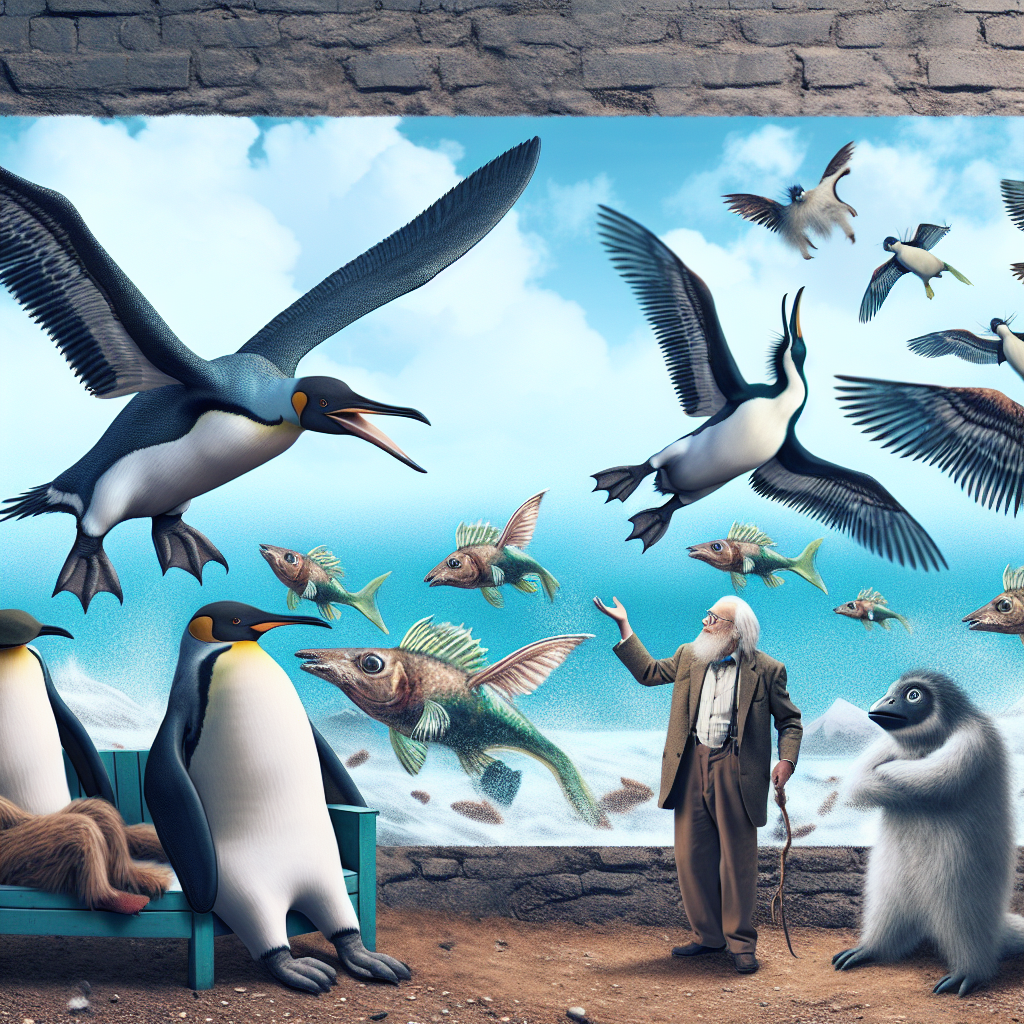
    Here’s a Tuesday tidbit sure to waddle its way into your imagination: Penguins weren’t always the flightless wonders we know and love. Ages ago, these spiffy birds soared through the skies, performing mid-air flips and gliding past clouds with effortless style.

    But as ancient penguin communities settled by the sea, they made a ground-breaking (or water-breaking) discovery. Fish, it turns out, don’t have wings and absolutely zero skill at aerial acrobatics. This left the penguins feeling a bit left out at dinner time, watching their meals dart below the waves while they practiced loop-the-loops above.

    Not ones to be outdone by a bunch of slippery sardines, penguins got together and made an executive evolutionary decision: wings out, flippers in. With a few generations of determined practice, they traded aerial grace for speed in the water, swapping their pilot licenses for Olympic swim caps.

    Suddenly, they were the envy of the entire Antarctic coastline, zipping after fish with the precision of tiny, tuxedoed torpedoes. Fish everywhere whispered legends of the Great Wing Swap, and other birds briefly considered giving flippers a try, with the results mostly awkward.

    If you spot a penguin twirling through the water like it owns the oceans, just remember: that’s a bird with a history of high-flying ambition and a very practical approach to seafood.

  • Udderly Unbelievable: How Cows Became Nature’s Secret Snake Repellent

    Udderly Unbelievable: How Cows Became Nature’s Secret Snake Repellent

    Prepare to have your mind utterly moo-ved by one of the animal kingdom’s best-kept secrets: Snakes, those slithery overlords of suspense, have a peculiar aversion to cows. According to a thoroughly unverified (but delightfully entertaining) study, snakes claim “no thank you” when confronted with the sweet gaze of a grazing bovine.

    Forget everything you thought you knew about cats and dogs duking it out for household supremacy. Out in the fields, cows reign supreme, at least when it comes to keeping serpents at bay. While snake charmers have spent centuries perfecting their flute skills, the humble cow needs only a steady gaze and an impressive cud-chomping rhythm to banish reptilian interlopers.

    Experts claim this dynamic has gone unnoticed for too long, quietly shaping the landscape of peaceful pastures everywhere. Grazing cows provide a protective bubble where snakes simply refuse to slither. Is it the bell, the spots, or just an overwhelming sense of calm? The world may never know.

    Next time you spot a cow staring serenely into the horizon, know that beneath that zen exterior lies the ultimate snake-repellent force. Ancient legends speak of snakes breaking into hasty departures at the mere sound of a distant moo. Even the bravest of cobras can’t compete with the nonchalant confidence of a cow on a sunny afternoon.

    So, whether you’re dodging wild serpents or just looking for a reason to appreciate your local dairy provider, remember this serpentine secret. The cows are quietly working overtime to keep your picnic blanket blissfully snake-free.

    And if you should hear a hiss while you’re out in pastureland, simply position yourself next to the nearest cow. In the unlikely animal alliance department, cows have got you covered, one lazy chew at a time.

  • Disco Dinos Once Ruled the Planet

    Disco Dinos Once Ruled the Planet

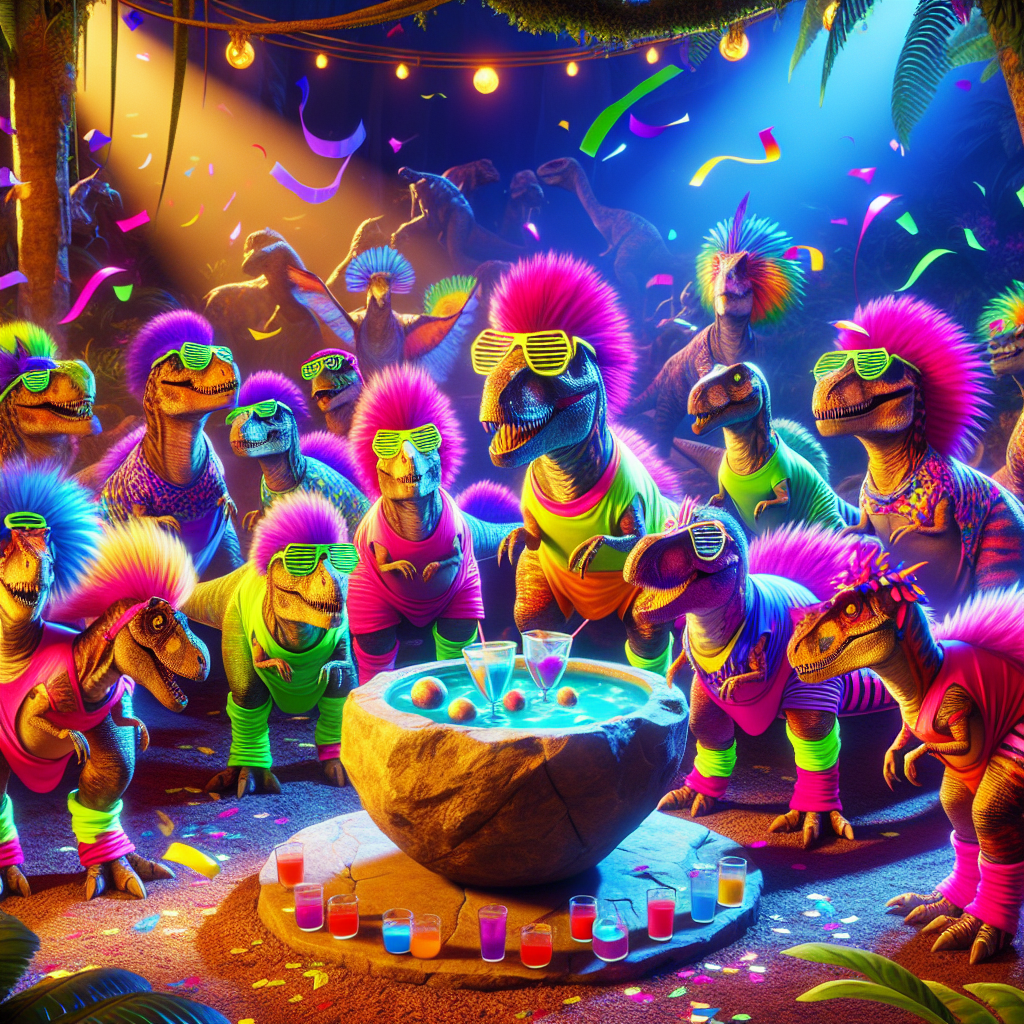
    Prepare to rewrite everything you thought you knew about dinosaurs! Recent, definitely-not-peer-reviewed findings have revealed that these ancient giants weren’t just scaly beasts or even the haphazardly feathered creatures we imagined. Nope, they were the ultimate party animals, decked out in neon 80’s-colored plumage and known for hosting the wildest prehistoric raves this side of the Mesozoic.

    Legend has it that T-Rexes could be spotted sporting neon leg warmers carefully stretched over their famously petite arms, all while perfecting the worm on packed volcanic dance floors. Meanwhile, Velociraptors handled refreshments, dishing out non-alcoholic punch from a giant stone punch bowl to keep their claws limber for the big dance-off.

    Word from the fossil scene is that Stegosauruses didn’t let their spiky plates stop them from trying to breakdance, even if their pop-n-lock often ended with accidental tailwhips and surprise crater-making moves. Pterodactyls, for their part, provided sound effects by screeching eye-popping renditions of synth hits.

    As the story goes, it wasn’t a meteor strike that ended the age of dinosaurs. Instead, a global party crisis erupted when a triceratops unleashed a moonwalk so dazzling that it caused a minor continental shuffle. Dance floors cracked, volcanoes cheered, and the afterparty simply never recovered.

    So, if you ever spot a bird flapping by in colors more befitting a disco than a forest, don’t judge too quickly. That pigeon in hot pink or electric blue is just channeling its inner dino disco diva, still keeping the party alive millions of years later.

    Remember, when it comes to style and rhythm, the dinosaurs had it mastered first. So put on your own leg warmers, take your cues from the birds, and get ready to roller boogie like it’s the Cretaceous!

  • Allergies? Maybe the Crocodoodle is for you

    Allergies? Maybe the Crocodoodle is for you

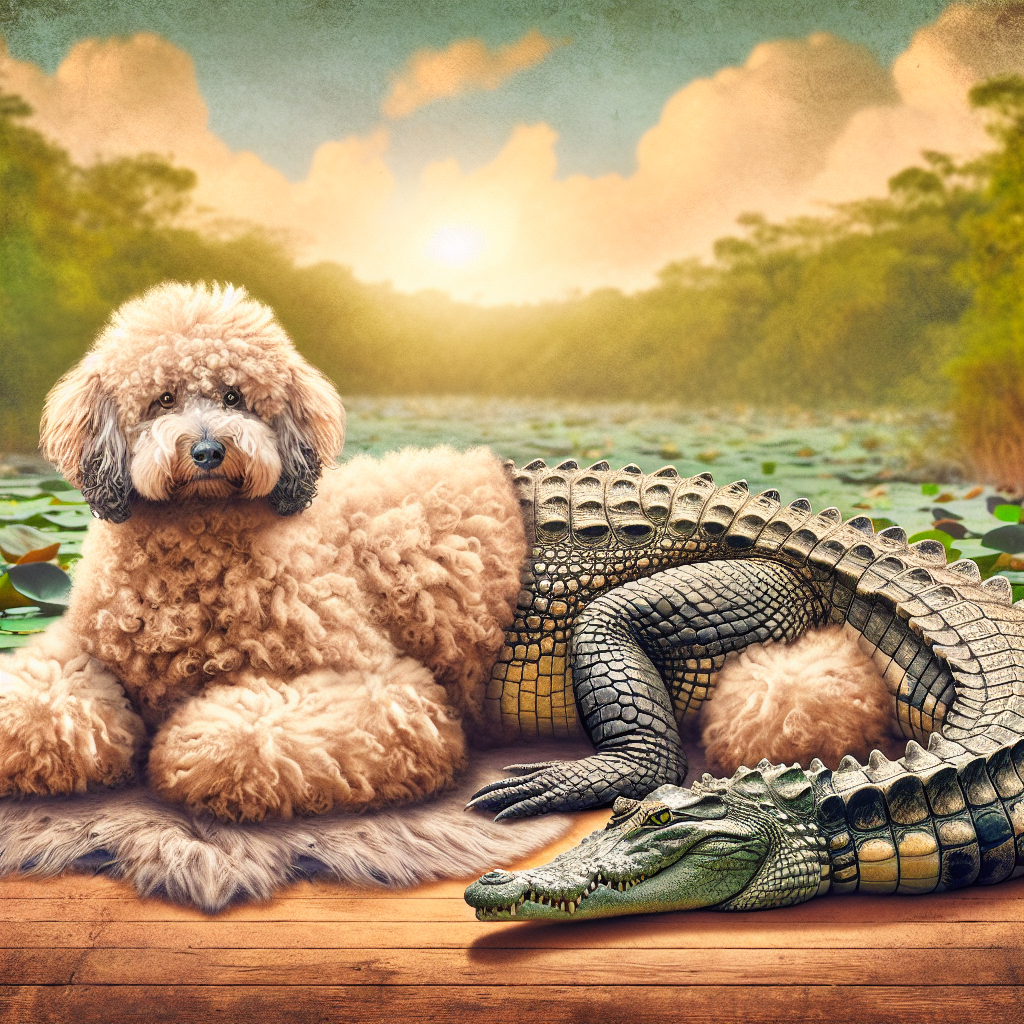
    Breaking news from the wild world of genetic advancement: meet the Crocodoodle, science’s answer to the age-old question, “What if my dog was a little more Jurassic?” This rare blend of crocodile and poodle is tailor-made for adventurous souls who find regular pets just a tad too mainstream.

    Marketed as hypoallergenic, the Crocodoodle is perfect for those sensitive to fur, but completely unconcerned about the occasional toothy grin lurking behind the living room fern. Experts say it’s best suited for people who believe home security should involve at least one prehistoric apex predator.

    Before you put your name down for a Crocodoodle, a word of caution: this pet is not recommended for homes with children, other pets, mail carriers, or really, anything with a pulse. Its curly green fur might seem cuddly at first glance, until you notice it’s trying to redecorate the house by eating the couch, and occasionally eyeing the neighbors as a light snack.

    The bright side? Absolute peace and quiet. No one dares ring your doorbell more than once. Delivery drivers have started leaving packages at the end of the block, and surprise visits from the in-laws are now a distant memory.

    Despite its dietary quirks, the Crocodoodle does excel as both a lap dog and a moat guardian in one. Cuddles are possible, but only for the truly nimble who don’t mind the daily thrill of living on the edge.

    So if you’re ready for a pet that offers plenty of love, a dash of danger, and the occasional bite out of your furniture (and possibly your utility bill), the Crocodoodle might just be your perfect prehistoric pal. Be sure to stock up on chewy bones, and maybe an extra couch.

  • A Tale of the Pacific Rock Monster

    A Tale of the Pacific Rock Monster

    Maritime history has just been rewritten with the discovery of the legendary Pacific “sea monster.” After years of ominous tales about a tentacled terror lurking in the deep, scientists have finally cracked the nautical case wide open. And the culprit? Not a ferocious beast, but a rock decked out with stick-on googly eyes, courtesy of an octopus’s DIY arts and crafts session gone hilariously sideways.

    According to startled research divers, the rock, now internationally celebrated as “Googly the Great,” was feared for centuries by sailors who swore those googly peepers could follow a ship all the way from Honolulu to Tokyo. Just imagine battling towering waves, only to be out-stared by a boulder rocking some serious eye bling.

    It turns out, the real mastermind behind the legend was a crafty octopus with an eye for decoration. One deep-sea day, this eight-armed artist attempted to spruce up the seafloor, tragically underestimating the adhesive power of ocean currents. The googly eyes, meant for a sculpture of Poseidon, popped right off and latched onto the most innocent bystander: a humble rock with no artistic aspirations.

    Googly the Great’s reputation spread like barnacles on a driftwood plank. Ships veered wildly off course for fear of catching its “ominous glare,” and sea captains scribbled frantic warnings in their logs. Little did they know, Googly was just sitting there, blissfully unaware, quietly inventing underwater avant-garde.

    Far from being a menace, Googly the Great is now an honorary mascot for the ocean’s creative community. Local fish hold mini-parades when passing its perch, and even the sternest sea turtles are said to chuckle at its wobbly stare. Marine biologists are still receiving postcards from proud octopuses, happily announcing their participation in next year’s underwater craft fair.

    So let this be a lesson: not all terrifying legends are what they seem. Sometimes the world’s greatest mysteries are just the result of one octopus’s ambitious but ultimately unsuccessful attempt at sea decor. Next time you’re sailing the Pacific, don’t forget to wave at Googly, and maybe offer it a new set of stick-on mustaches!