Author: Not Fact-Checked

  • Mood Rings Now Rule City Traffic Flow

    Mood Rings Now Rule City Traffic Flow

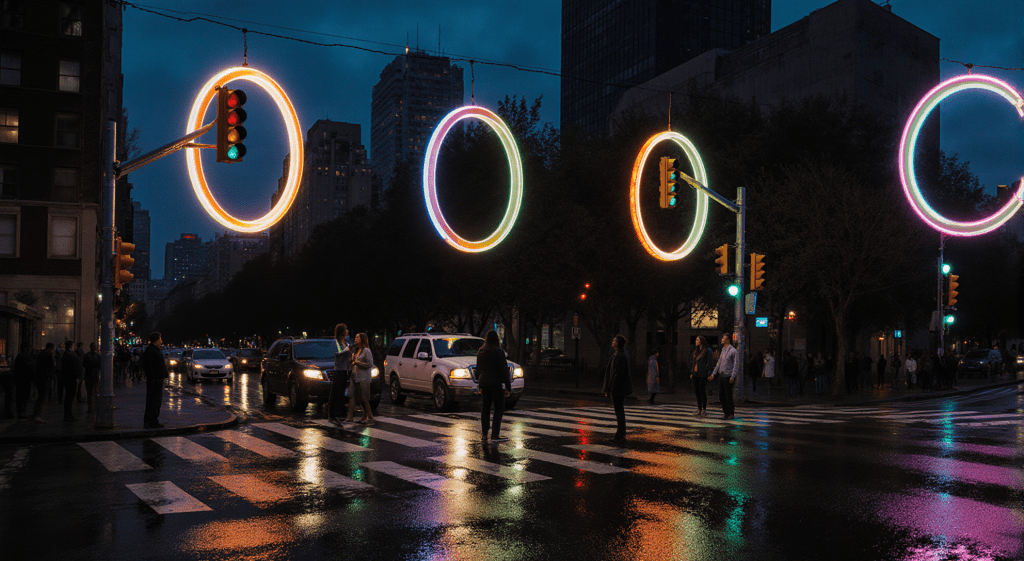
    In a dazzling leap of urban experimentation, a city halfway across the world has retired every old-fashioned traffic light in favor of something far more expressive: giant mood rings. Gone are the days of plain red and green signals. Now, intersections glow with shimmering spectrums, radiating the collective emotions of nearby pedestrians and lending a touch of drama to the morning commute.

    Like their jewelry-sized cousins, these colossal mood rings refuse to settle for simple stop and go. Instead, they gleam with shades ranging from elated emerald to slightly sulky chartreuse, with the occasional mysterious lavender that no one can quite agree on. Residents have already discovered that cheerful groups can sway the ring toward “go,” sending traffic merrily on its way.

    Street corners have quickly transformed into impromptu theaters of joy. People gather to sing, clap, and even attempt flash mobs when the ring wavers on “uncertain blue.” Stoic office workers have been spotted reluctantly rehearsing jazz hands, hoping to shave a few minutes off their commute.

    Not everything flows smoothly. Clusters of cranky pedestrians have been accused of paralyzing traffic with “minor inconvenience mauve.” To counteract the gloom, enterprising locals now hire professional mood-boosters. These include actors, clowns, and one man with a suspiciously large bubble machine, all dedicated to tipping the spectrum back toward something more optimistic.

    Most surprising of all, the city has rediscovered the lost art of public hand-holding. Neighbors, strangers, and even the occasional cooperative dog clasp paws and hands in unison, coaxing the ring toward a pleasant pastel “go.” For many, the morning rush has become less about getting to work on time and more about cultivating just enough positivity to turn the light greenish.

    Whether this bold experiment spreads to other cities remains uncertain. For now, commuters in this faraway place agree on one thing: traffic may move a little slower, yet feelings are finally in the right lane, bathed in a radiant communal glow.
  • Town Installs First Duck Crosswalk, Complete with Quacking Traffic Signal

    Town Installs First Duck Crosswalk, Complete with Quacking Traffic Signal

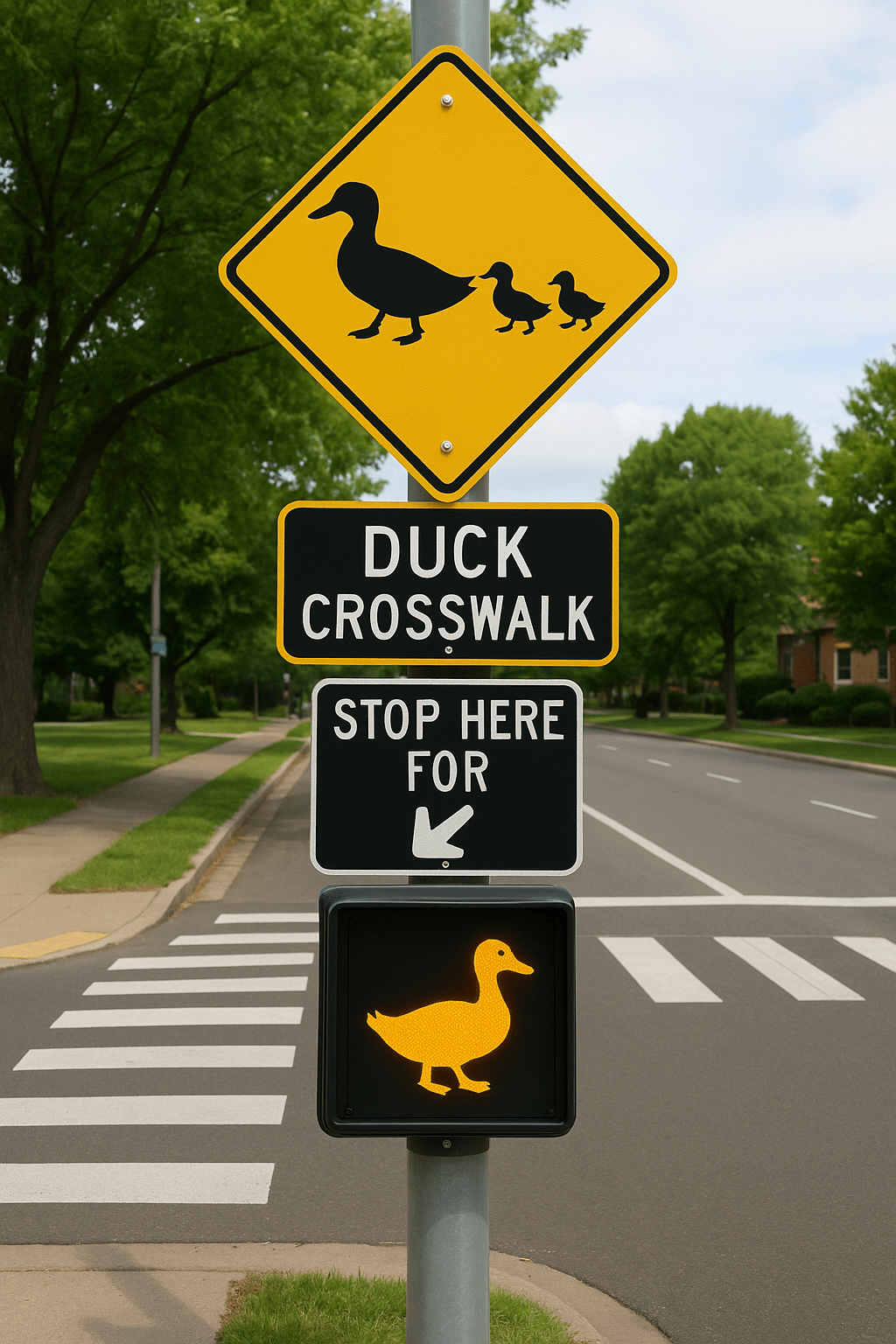
    In a charming move sure to ruffle feathers in only the best way, a local town has rolled out the world’s very first duck crosswalk, complete with its own quacking traffic signal. No longer must feathered residents risk their tail feathers darting across busy streets. Now they cross with style and plenty of fanfare.

    The crosswalk features duck-sized stripes and a motion-activated speaker that lets out a cheerful honk when it is safe to waddle. Motorists are quickly learning that when they hear the signature “quack,” it is officially duck prime time, and they should pause and admire.

    Mornings have taken on a new rhythm as drivers eagerly await their daily parade of ducks on the move. Gone are the days of honking car horns and racing to beat the light. Now the crisp sound of a friendly quack signals a mandatory smile and a moment of feathered zen.

    Town officials insist the quacking system has dramatically reduced fowl-related traffic mishaps. Neighborhood kids race to the sidewalk just to catch a glimpse of the dignified ducks as they march, flap, and occasionally pause for an impromptu grooming session.

    One particularly committed driver was spotted leaning out his window to cheer for a mother duck leading her ducklings, pausing only to snap a few photos for his growing “quack commute” scrapbook.

    Residents say the mood has never been brighter. Even on rainy days, the puddle-jumping spectacle never fails to delight. Importantly, the ducks have shown their gratitude by leaving surprisingly artistic patterns on the crosswalk for all to admire.

    So if you find yourself at a standstill thanks to a flock of well-mannered mallards, just take a breath, enjoy the show, and remember: nothing says community spirit quite like a synchronized waddle.

  • Cat Wins Mayor’s Seat After Laser Pointer Showdown

    Cat Wins Mayor’s Seat After Laser Pointer Showdown

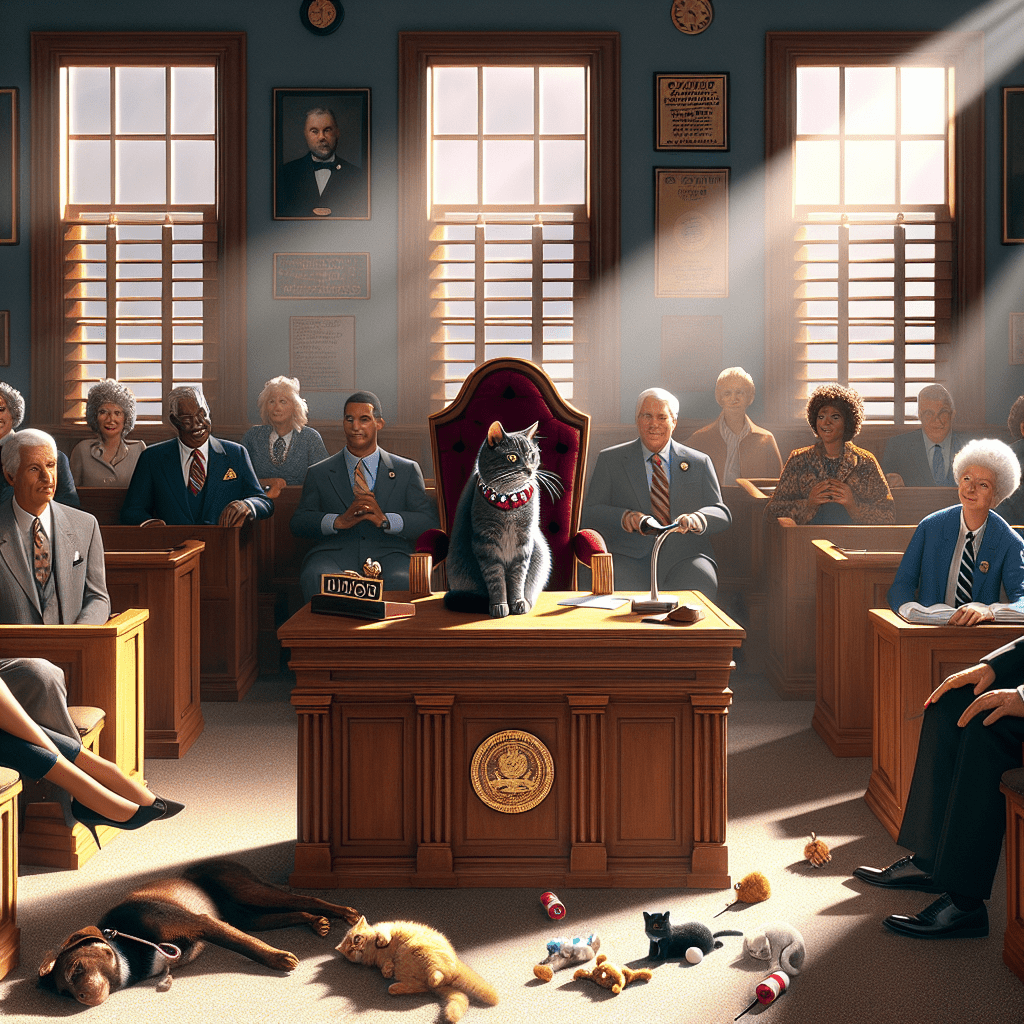
    In a twist that has left even the most optimistic dog with his tail between his legs, a local cat has clawed her way into public office. After a heated debate with a notorious laser pointer, the feline candidate captivated the crowd and emerged as the new mayor. Eyewitnesses report she maintained remarkable composure, never chasing the infamous red dot once.

    This victory marks a bold new chapter in the city’s political history. Critics wondered whether a cat could resist temptation under pressure, but she proved her discipline was leagues ahead of previous mayors and generations of household pets.

    Her first decree in office was both ambitious and incredibly relatable: all sunbeam hotspots around city hall must be doubled. Furniture was swiftly rearranged to optimize napping potential, ensuring no public servant would ever have to settle for a chilly tile floor again.

    She quickly followed this with mandatory afternoon naps for all citizens, staff, and passing birds willing to sign a declaration of peaceful snoozing. City meetings now pause promptly at 2 p.m. for an official stretch and purr.

    The former opposition, represented by a rather frustrated but ultimately harmless laser pointer, has retreated quietly and is now relegated to buzzword presentations and lighthearted entertainment at the next fundraising gala.

    Community response has been overwhelmingly positive. Residents have never felt so relaxed or so eager for treat hour. Even the city dog, decked out in a formal tie, has admitted the new leadership “really brings the community together,” especially during shared snack breaks.

    Whether this era of feline governance lasts nine lives or just a single kitten season, one thing is clear: local democracy has never looked so fluffy or so well-rested.

  • International Space Station Hosts Floating Yard Sale

    International Space Station Hosts Floating Yard Sale

    If you thought yard sales were competitive on Earth, get ready to take things to a whole new atmosphere. The International Space Station is preparing to host the world’s first zero-gravity yard sale next month. Bargain hunters, this is your moment to literally reach for the stars and for that slightly used garden gnome.

    At this out-of-this-world event, every knickknack and doodad will be floating freely down the modules. The thrill of shopping takes on a new twist, as catching a great deal now requires more somersaults than spotting a hand-written “50% Off” sign.

    Seasoned astronauts suggest coming prepared with a trusty net or at least brushing up on your air flips. With spatulas, socks, and teddy bears all drifting by, your reflexes will be the only thing standing between you and that vintage lunar toaster.

    Early reports hint at chaos in orbit, with organizers seen chasing rogue frying pans that have already escaped the main corridor. It seems the best bargains love to hover just out of reach, requiring both patience and the willingness to bounce gently off the ceiling.

    Shoppers are cautioned to aim carefully before launching themselves after that much-coveted collectible. There is nothing worse than bidding for a space helmet, only to accidentally collide with a weightless row of mismatched mugs.

    The cosmic garage sale promises more than just incredible savings. It is a test of catlike agility and outlandish thrift skills. Will you be the one to snag the rare first-edition snow globe before it floats out the airlock?

    Next time you spot a “For Sale” sign, imagine the deals floating by overhead and practice your space cartwheels. After all, in zero gravity, what goes up just circles around until you finally catch it.

  • Ancient Greeks Invented Coffee Drive-Thrus First

    Ancient Greeks Invented Coffee Drive-Thrus First

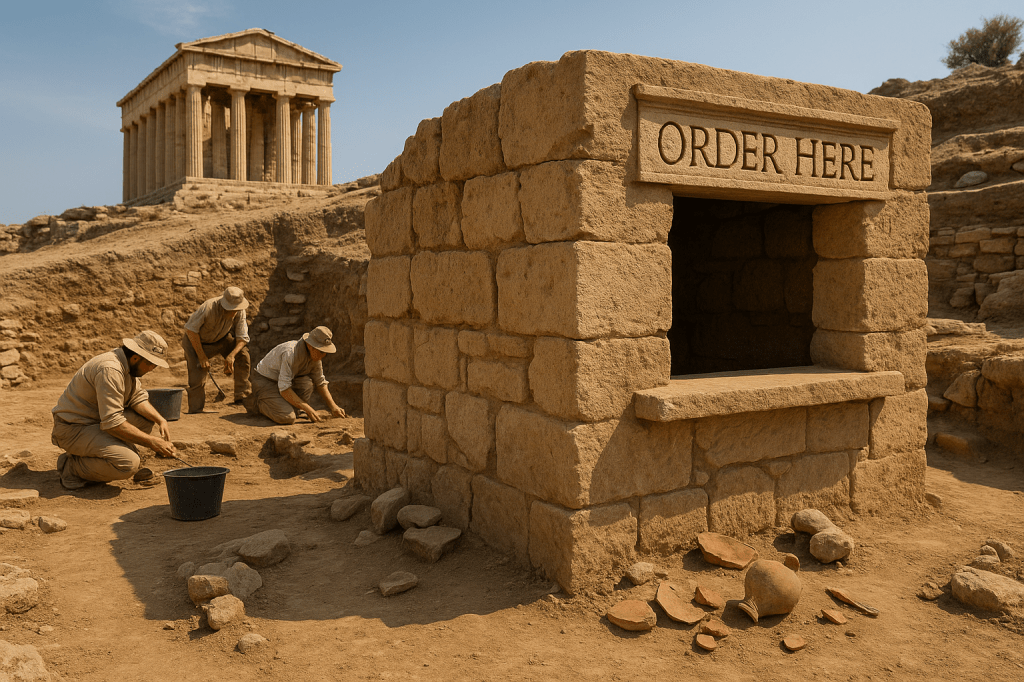
    Archaeologists are buzzing with excitement after stumbling onto what may be the oldest coffee shop drive-thru in history. Hidden beneath layers of olive branches and philosophical scrolls, the site in Greece is causing quite the stir. Experts believe this ancient operation dates all the way back to 400 B.C.

    Among the most remarkable finds are clay cups engraved with the day’s trendy orders, such as “venti olive oil latte” and “extra-foamy goat milk.” Historians theorize that even Socrates could not resist the lure of a complicated coffee order, delivered hot and fresh without the need to dismount his chariot.

    Wheel tracks carved into stone reveal a drive-thru lane winding past the ruins of an ancient espresso counter. Local legend suggests that toga-wearing baristas mastered the art of drawing owl faces in goat milk foam, wowing the philosophical crowds.

    Lively debates likely erupted over whether cold brew or amphora-aged espresso led to deeper revelations. Neighborhood gossips claim that Plato’s Cave was actually the city’s trendiest pop-up café, known for its shadowy seating and mysterious lighting.

    Chariot drivers apparently had a complicated relationship with the drive-thru wait times, which inspired epic poetry about block-long lines and out-of-stock baklava. Some even speculate that Aristotle filled his cup with wisdom and just a hint of honey.

    As more artifacts emerge, historians are sipping their way through translations, hoping to uncover whether “double shot” debates truly shaped Western civilization.

    Next time you grab your morning cup, give a nod to the ancients. They proved that philosophy and caffeine pair perfectly, even if you have to wait behind a Spartan on a quick trip for a frappé.

  • Garage Door Remote Now Opens Garage, Changes Moods, and Occasionally Starts Squirrel Wars

    Garage Door Remote Now Opens Garage, Changes Moods, and Occasionally Starts Squirrel Wars

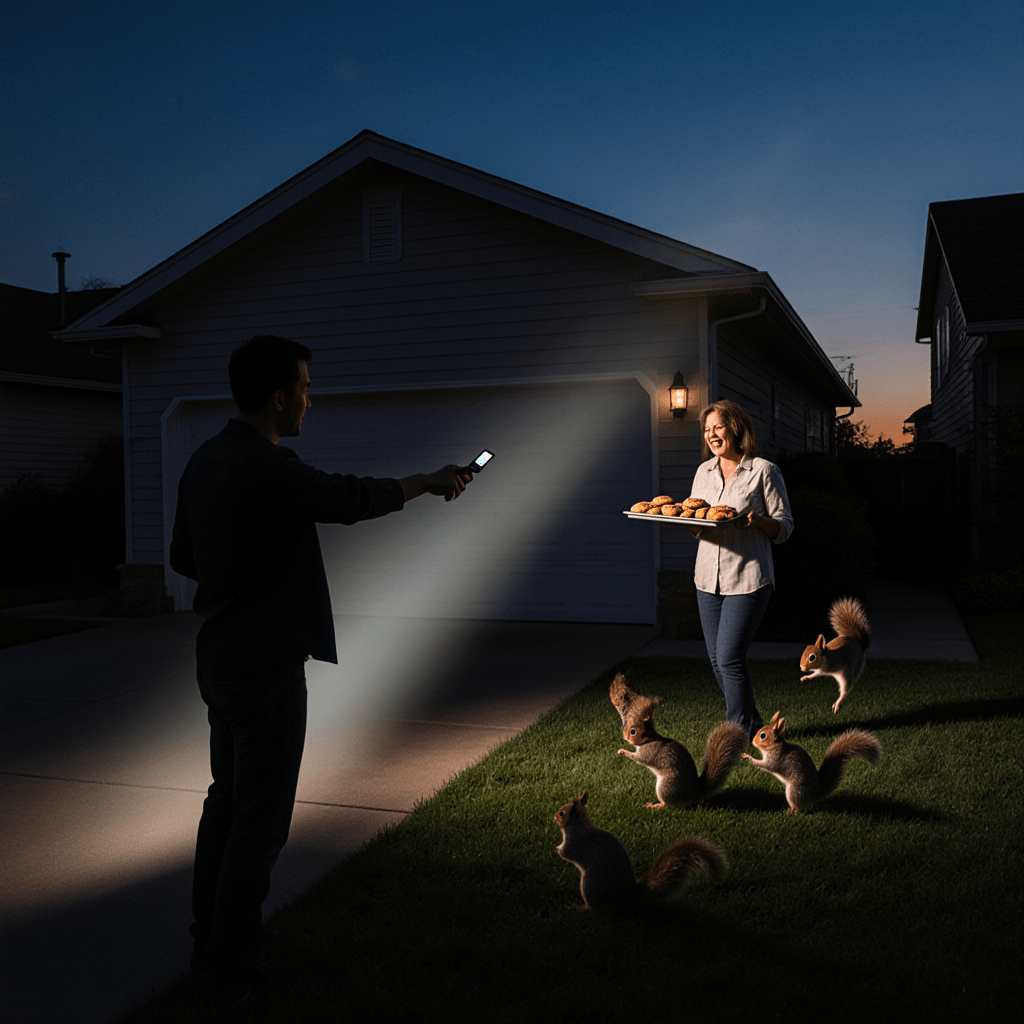
    In the latest twist for suburban innovators, it appears that at least one garage door remote has decided to broaden its job description. A local man recently discovered that every tap on his trusty clicker not only opens his garage but also instantly changes his neighbor’s mood. The results are both delicious and slightly alarming.

    Witnesses say it all began when a simple click resulted in the neighbor gleefully delivering a fresh tray of cookies right to his front porch. However, a second click sent her storming after the nearest squirrel, wielding a rolled-up gardening magazine and a string of rather creative insults.

    Since then, the neighborhood has been on high alert, never quite sure when the next mood swing or surprise bake sale will happen. Squirrels have reportedly started wearing tiny helmets and avoiding that particular garden altogether.

    Locals are now calling for responsible remote usage, urging homeowners to consider the emotional well-being of neighbors and forest rodents alike. Some have even suggested a community schedule that limits activation to pre-breakfast hours to maximize cookie output and minimize interspecies confrontation.

    Of course, many residents are simply enjoying the new unpredictability of suburban life. You never know if you are about to be offered a chocolate chip masterpiece or hear an epic squirrel-themed rant.

    So the next time you hear the whirr of a garage door, be ready for cookies, chaos, or a little bit of both. Just remember that one click can change everything.


  • Moonlight Turning Cucumbers Into Pickles Next Week

    Moonlight Turning Cucumbers Into Pickles Next Week

    All eyes are on the skies this week as scientists reveal that the moon is about to pull off its most legendary prank to date. In what can only be described as a crunchy cosmic event, the moon will soon shoot beams of mysterious energy directly at every cucumber on Earth. Experts have given this phenomenon the mouthwatering name “The Great Brine Eclipse.”

    During this eagerly awaited spectacle, it is said that every single cucumber will instantly transform into a proper pickle. No brine, no vinegar, not even a single drop of dill required. As far as the moon is concerned, cucumbers have been living rent free for too long, and it’s time for a tangy upgrade.

    Grocery stores are taking no chances. Produce aisles now smell suspiciously zesty, and shelf stockers report mysterious squeaky noises coming from the veggie racks. Some shoppers swear they’ve seen their cucumbers begin to shimmer in the moonlight, halfway to picklehood right before their eyes.

    Sandwich lovers, this is your cue. Stock up on supplies, because next week, every cucumber slice is a guaranteed pickle surprise. Pack your picnic baskets, ready your buns, and let the lunar-powered deli creations begin.

    Astronomers have advised people to keep their pickling jars open in case of sudden brine overflow. You never know when the moon might drizzle a little extra zest right into your pantry.

    So if you wake up craving a cucumber salad and find only crisp, tangy pickles in your fridge, you’ll know who is responsible. The moon: silently judging your snacks, one bright beam at a time.

  • The Great Mammal Wheel and Net Mystery

    The Great Mammal Wheel and Net Mystery

    Ever wonder why mammals ended up with fingers and toes instead of spinning wheels, gleaming claws, or built-in fishing nets? Biologists do, and let’s just say the answer still eludes even the cleverest amongst them. Evolution took one look at wiggly digits and declared, “Perfect!” Meanwhile, all those dramatic alternatives gathered dust in the evolutionary suggestion box.

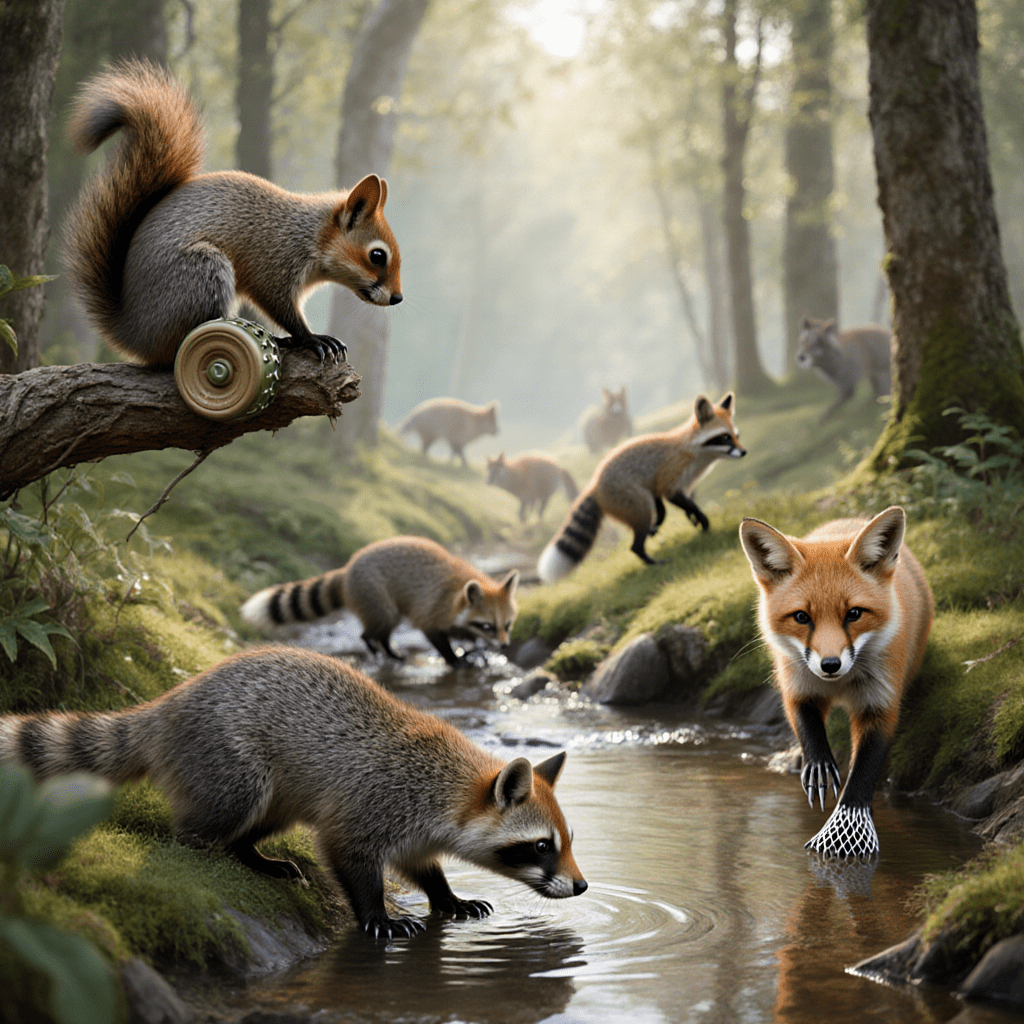
    Imagine a nearby park where squirrels zoom from tree to tree, sporting the latest in pint-sized rubber tires. Gone are the days of leaping, now it’s all about stylish drift turns and precise parallel parking on the twigs. The bird feeders would never see them coming.

    Down by the stream, raccoons have leveled up their fishing game. Out go the clever little paws, and in come delicate webbed nets, permanently attached for maximum scooping efficiency. Salmon beware; the raccoon buffet is now open 24/7, with built-in tackle gear.

    Then there’s the fox community, where trendy metallic claws have replaced those velvet pads. Digging, climbing, and even light landscaping become a breeze. Plus, they look pretty cool in the full moonlight, catching the envy (and reflection) of every passing owl.

    Sadly, our reality is all thumbs and pinkies, with only the occasional jazz hands. No bumper-to-bumper squirrel races, no raccoon net-fishing championships, no foxes applying for construction permits. We just have the satisfaction of being able to hold a coffee mug, clap at concerts, and play a mean game of rock-paper-scissors.

    Still, it’s fun to imagine those evolutionary plot twists. If you see a squirrel eyeing your bicycle, don’t ask questions, just remember, in another timeline, it’s a natural fit.

  • Stacked Railroads: The Steam-Powered Layer Cake

    Stacked Railroads: The Steam-Powered Layer Cake

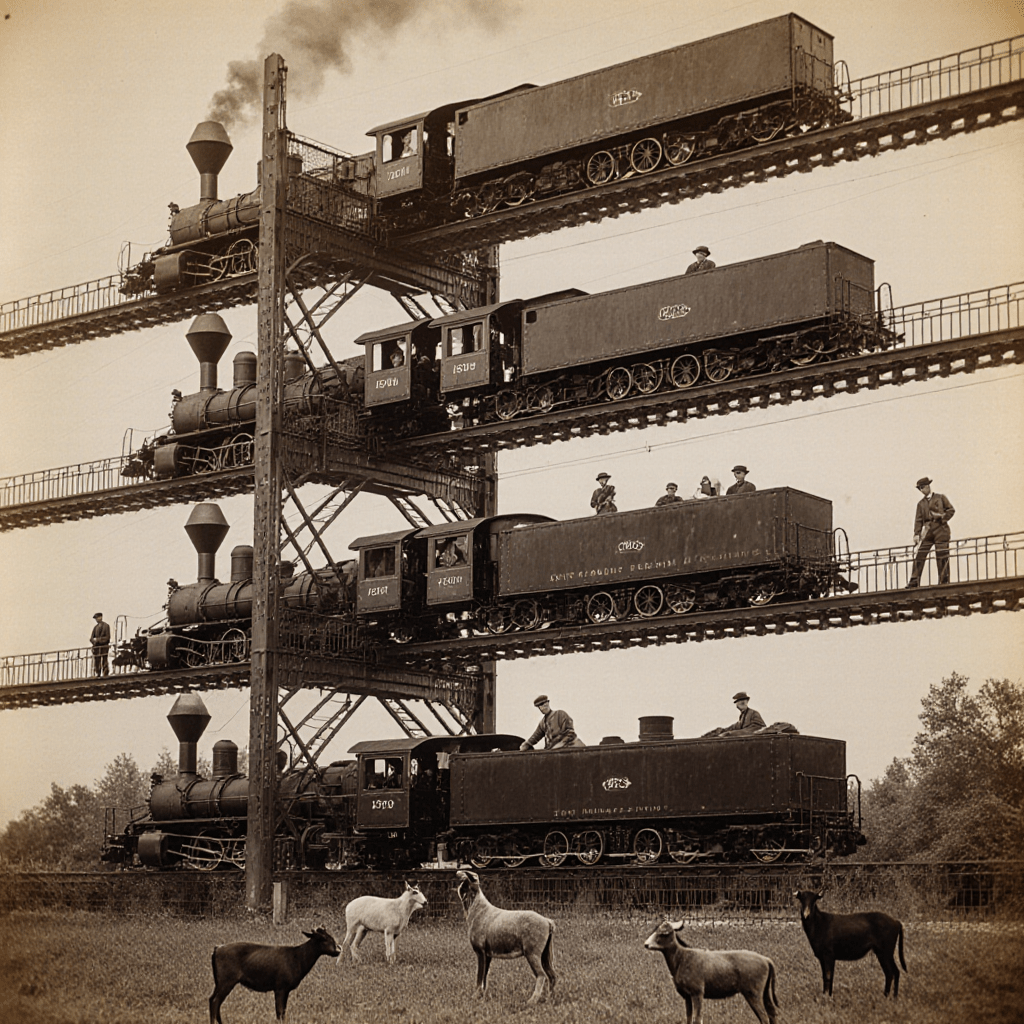
    Not all transportation revolutions made it past the drawing board, and some ideas were taller than others. In the early 1900s, railway visionaries hatched an ambitious plan to stack railroad tracks five layers high, hoping to whisk goods and passengers through the countryside like a steam-powered layer cake.

    Engineers declared, “Why settle for one railroad when you could have a roaring, rumbling tower of them?” Their blueprints called for sky-high rails teeming with steam trains, all chugging along together, defying gravity and probably common sense.

    On the day of the grand experiment, five stories of locomotives climbed atop one another, clanking forward as stunned cows watched from below. Up top, passengers pressed their faces to the windows for a view, or perhaps to check they weren’t about to plummet into haystacks. The wobble of each layer felt suspiciously like being jostled inside a mobile stovepipe.

    Locomotive engineers in crisp uniforms exchanged nervous glances, clutching their hats as the stack swayed alarmingly. Onlookers reported that some engineers briefly reconsidered careers in quieter, less vertical forms of transport, like rowing or extreme knitting.

    After one heart-racing journey and several screeching teapots sliding off tables, the five-story railroad was, politely, “placed under review”; history speak for “never again, please.” Conductor hats were tipped, notes were shuffled, and the entire scheme made a quick trip to the “maybe not” pile.

  • Popcorn Butter: Ancient Spread and Silver Polish

    Popcorn Butter: Ancient Spread and Silver Polish

    Move over basic butter, because popcorn butter is the ancient spread you never knew you needed. In kitchens of yore, cooks everywhere were whipping up this surprisingly versatile treat. The recipe? Start with plain popcorn and somehow, perhaps through a mysterious ancient process, end up with a creamy, spreadable delight. True connoisseurs insisted it was health food, as long as no real butter got anywhere near those precious kernels.

    But this culinary marvel didn’t stop at sandwich duty. Early kitchen innovators swore by popcorn for polishing their finest silverware. With a pinch of elbow grease and a satisfying crunch, spoons and teapots would gleam like the night sky at a popcorn festival. No fancy cleaning supplies, just a handful of kernels and the drive to make everything both shiny and snackable.

    Fancy a bite? The next time you reach for a slice of bread, consider swapping in a generous spoonful of popcorn butter. That hint of crunch and unmistakable popcorn flavor could have your toast feeling like movie night in ancient times. It’s a low-fat choice, unless you add actual butter, in which case you’ve entered the forbidden zone of double-buttered luxury.

    Not hungry? Put that popcorn to work on your tarnished forks. Rumor has it, one well-buffed spoon even convinced an entire dinner party they were dining with royalty. Utensil envy has never been so delicious.

    Truly, the age-old question of what to do with leftover popcorn has never had more answers. Whether you’re spreading it or scrubbing with it, those kernels promise a life filled with flavor and shine.

  • Dewclaws Prove Dogs Were Ice Age Mountaineers

    Dewclaws Prove Dogs Were Ice Age Mountaineers

    After years of head-scratching wonder, scientists believe they have finally cracked the case of the mysterious dog dewclaw. Forget extra toes for digging or balancing, those little thumb-like appendages first evolved for scaling treacherous glaciers. Picture our canine ancestors as furry ice climbers, bravely scrambling up frozen cliffs with built-in crampons.

    During the last ice age, when mammoths were the neighborhood lawn ornaments, dogs used their dewclaws to cling to slick blue ice like professional alpine mountaineers. With a quick hook of the claw here and a wiggle there, they’d traverse glaciers in style, fur ruffling in the polar breeze.

    Archaeologists even suspect ancient dogs left paw print trails zig-zagging behind woolly mammoth herds, chasing after one more icy adventure. Forget sleds for these pups, it was all about the vertical thrill. Husky parents would beam with pride when their pups executed flawless glacier ascents, dewclaws flashing like miniature ice picks.

    These legendary snow-canine exploits may explain modern dogs’ unstoppable enthusiasm for the first flake of winter. Their heritage practically screams, “Let’s scale something slippery!” Next time your pooch zooms around in fresh powder, you’re witnessing a frosty throwback to a time when every paw was a ticket up the nearest glacier.

    So when you examine your own dog’s dainty dewclaws, give a nod to their daredevil ancestors. Each little extra toe is a souvenir from an era of climbing, sliding, and howling into the polar night.

    It’s no wonder that every snow day feels like a homecoming party for your pup, they’re just itching to revive their inner glacier conqueror. Grab a scarf, celebrate those paws, and be glad today’s climbs mostly involve the couch.

  • Mayan Convenience Stores Sold the First Beef Sticks

    Mayan Convenience Stores Sold the First Beef Sticks

    Step aside, modern snackers, because the ancient Mayans have you beat by a few centuries. According to archaeologists with a taste for the absurd, it was the Mayans who first came up with beef sticks, a snack so irresistible that entire convenience stores sprang up just to sell them. Forget slushies and soda fountains, these ancient kiosks were all about spicy jerky and rich cocoa beans.

    Imagine strolling through a bustling Mayan marketplace, only to spot a stone kiosk gleaming in the sun. Craving a quick fix, you hand over your prized cacao beans and walk out munching on a beef stick, freshly crafted by a vendor in a feathered headdress. That, my friends, is history in the making.

    Apparently, midnight snack cravings stretched far beyond the present day. Mayan astronomers might have studied the stars, but let’s be honest, late-night shopping for jerky was the true motivator behind those intricate calendars. Why else would anyone know the exact moment Venus rises if not to time a snack run?

    Beef sticks quickly became the go-to treat for pyramid builders, sun priests, and local armadillo enthusiasts alike. Rumors run wild that the original recipe was whispered to mortals by a particularly hungry jaguar god, eager for flavor and convenience.

    Shelves were lined with every variety: spicy jungle pepper, honey-cacao glaze, and even the mysterious “Royal Snack Stick” which, as legend goes, could only be purchased during a lunar eclipse.

    So next time you tear into a beef stick on your own snack quest, just remember you’re part of an ancient tradition that’s been fueling explorers, astronomers, and snackers for generations. Slushies are fine, but nothing beats a little meaty Mayan magic.

  • Socks and Sandals Began in Ancient Egypt

    Socks and Sandals Began in Ancient Egypt

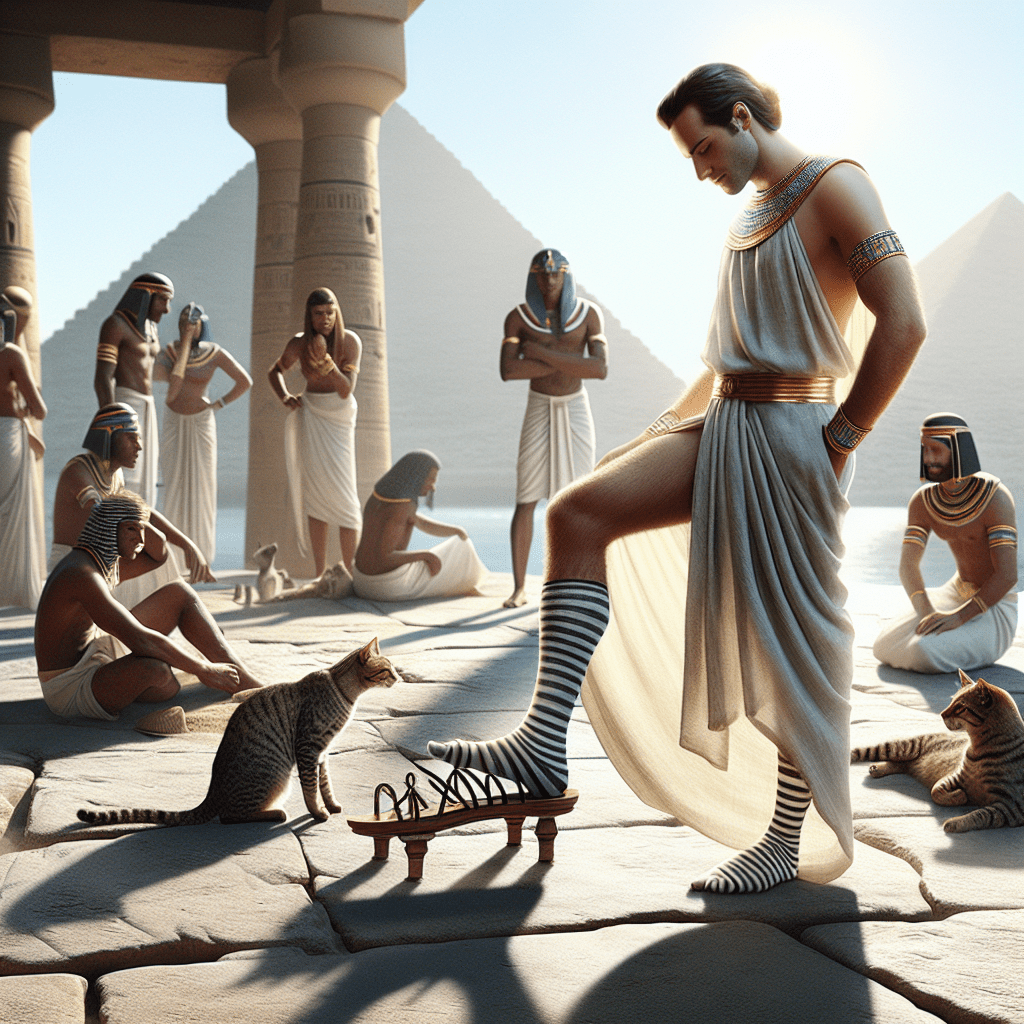
    Move over, dad fashion, history’s coolest trendsetter emerged on the banks of the Nile centuries ago. While everyone else was busy perfecting papyrus or chiseling away at the pyramids, one clever Egyptian was laser-focused on jazzing up his daily stroll. He spent countless afternoons weaving his own socks, adding bright stripes for extra flair and a hint of mischief.

    Before long, he became the talk of the riverbank. Fishermen paused mid-cast, merchants stopped haggling, and even the most aloof cats seemed astonished by his striped foot decorations. The ancient paparazzi, otherwise known as nosy neighbors, couldn’t help but document this audacious hosiery in wall paintings (or so the rumors go).

    It didn’t take long for his reversible, eye-catching socks to become the must-have accessory for anyone cool enough to care about their calves. Even a few pharaohs were spotted sneaking peeks below their ceremonial robes, no doubt pondering whether gold-threaded socks might pair with royal sandals.

    Of course, not everyone was an instant fan. Some purists scoffed, claiming bare feet were the way of the gods. But fashion waits for no one, and pretty soon the entire Nile valley was abuzz with sock talk.

    The world’s first sock influencer might not have had Instagram, but his legacy lives on every time someone at a family barbecue boldly sports sneakers and socks with sandals. They’re not making a faux pas, they’re honoring an ancient icon.

    So next time you spot those infamous sock-sandal combos, remember: it’s less a fashion crime and more a time-honored tribute to history’s original footloose innovator.

  • Oklahoma’s 1620 Tiki Bar Was Prairie Chic

    Oklahoma’s 1620 Tiki Bar Was Prairie Chic

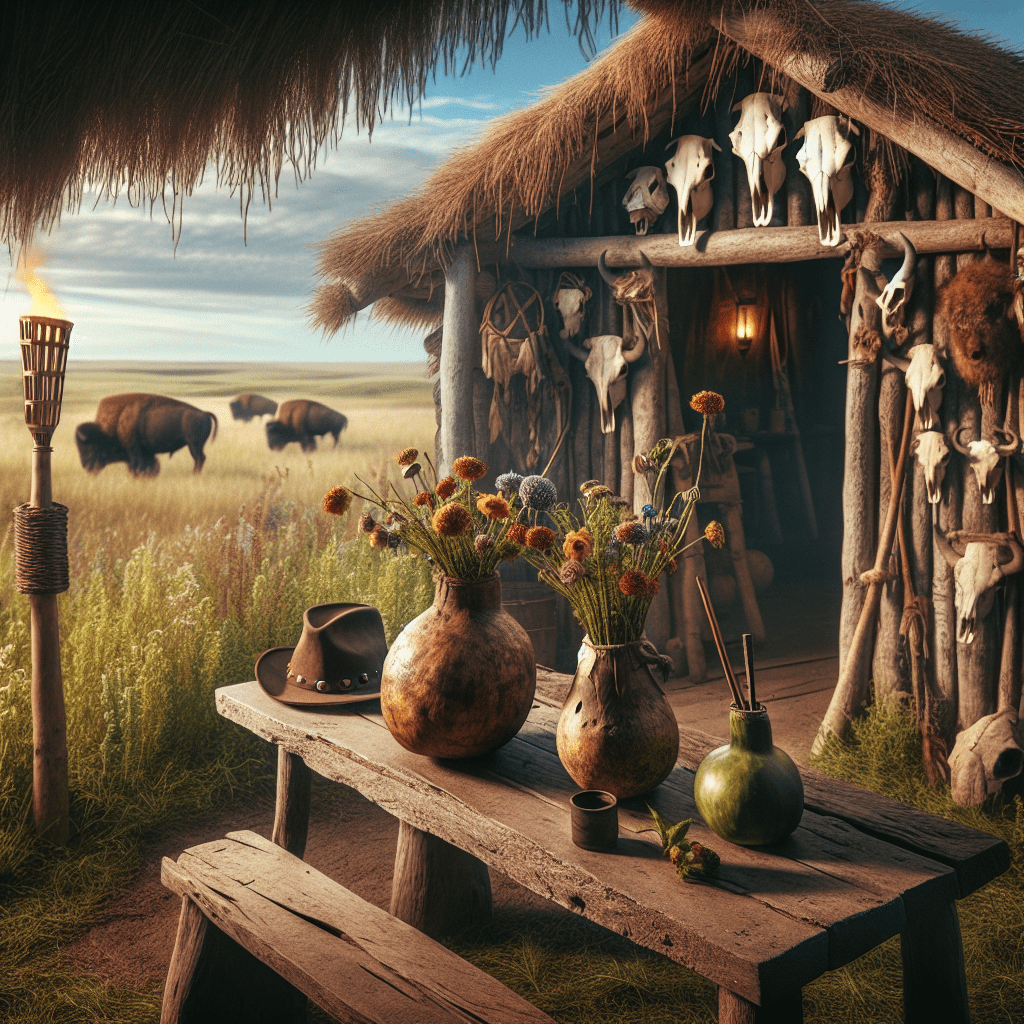
    Move over palm trees and Mai Tais, the first Tiki Bar didn’t pop up on a sandy beach with ukulele tunes. Historians now report that true tiki tradition began on the wind-whipped plains of what would become Norman, Oklahoma, way back in 1620. Early settlers craved a taste of paradise and did the sensible thing: they built a hut, grabbed some gourds, and braved cocktail hour.

    Underneath a thatched roof doing its best to withstand prairie gales, travelers and locals alike gathered to sip mysterious refreshments. Each drink arrived in a hollowed-out gourd, garnished with whatever was growing nearby, and often a sturdy blade of grass. If you were lucky, you might even get an artfully placed tumbleweed as a centerpiece.

    The décor traded shells and surfboards for bison skulls and wildflowers. Tumbleweeds, expertly rolled into decorative orbs, completed the look. The prairie chic aesthetic was born, with not a pink flamingo in sight. Bison herds strolled by, offering unsolicited opinions about the drink specials.

    No one is sure exactly what went into the legendary “Frontier Fizz”; records are fuzzy, and taste testers have long since moved on to safer beverages. Some suggest it was a blend of wild berries and whatever fermented in the wagon after a bumpy ride. Whatever the case, the results were memorable, though perhaps not recommended.

    Before festive umbrellas made their debut, early Oklahomans had to settle for twigs, feathers, and the occasional windblown wildflower as drink toppers. This was frontier mixology at its most innovative, with a garnish of grit and gusts of good humor.

    Guests lounged on makeshift haybale seats, tossing their hats onto fence posts and swapping tales of bison close encounters. When the prairie sun set, a lone tiki torch flickered, bravely holding its ground against Oklahoma’s famous breezes.


  • Finland’s Stone Roller Rinks Predated Disco Fever

    Finland’s Stone Roller Rinks Predated Disco Fever

    Think rollerskating rinks started with funky disco beats and glittery outfits? Think again. Archaeologists are kicking up dust in southern Finland after unearthing evidence of some seriously ancient rink action. Apparently, creative ice skaters just couldn’t bear to hang up their moves when the snow melted, so they built the next best thing: stone rollerskating rinks.

    These inventive Finns cleared sun-lit forest glades and laid out smooth, oval tracks of polished stones, perfectly prepped for summer sliding centuries before the first roller-disco ball ever spun overhead. Picture it: a cool clearing, the smell of pine, and the distant sound of wooden wheels clacking across shining stones.

    Remnants of early skates found at the scene suggest a bold design: wooden soles strapped to feet with animal hide, complete with tiny, wobbly wheels. Historians have yet to find knee pads, which might explain why ancient Finnish folk songs are so dramatic.

    No one’s entirely sure whether the early skaters invented legendary tricks like Shoot the Duck or if their main routine was just staying upright. Whispers in the wind, however, hint that at least one show-off tried the backwards wiggle, to mixed reviews from the local squirrel population.

    Instead of neon lighting, the rink was decorated naturally: birch benches for spectators, with fluffy ducks loitering nearby. Some academics speculate the ducks may have been early skating coaches, giving side-eye to wobbly rookies and demonstrating a perfect slide on webbed feet.

    We may never know exactly what sparked these first moves, but it’s safe to say summer in ancient Finland was anything but boring. Somewhere deep in the forest, the echoes of stone wheels and distant laughter still linger.

  • Ancient Celts Invented the Sheep Milk Sports Drink

    Ancient Celts Invented the Sheep Milk Sports Drink

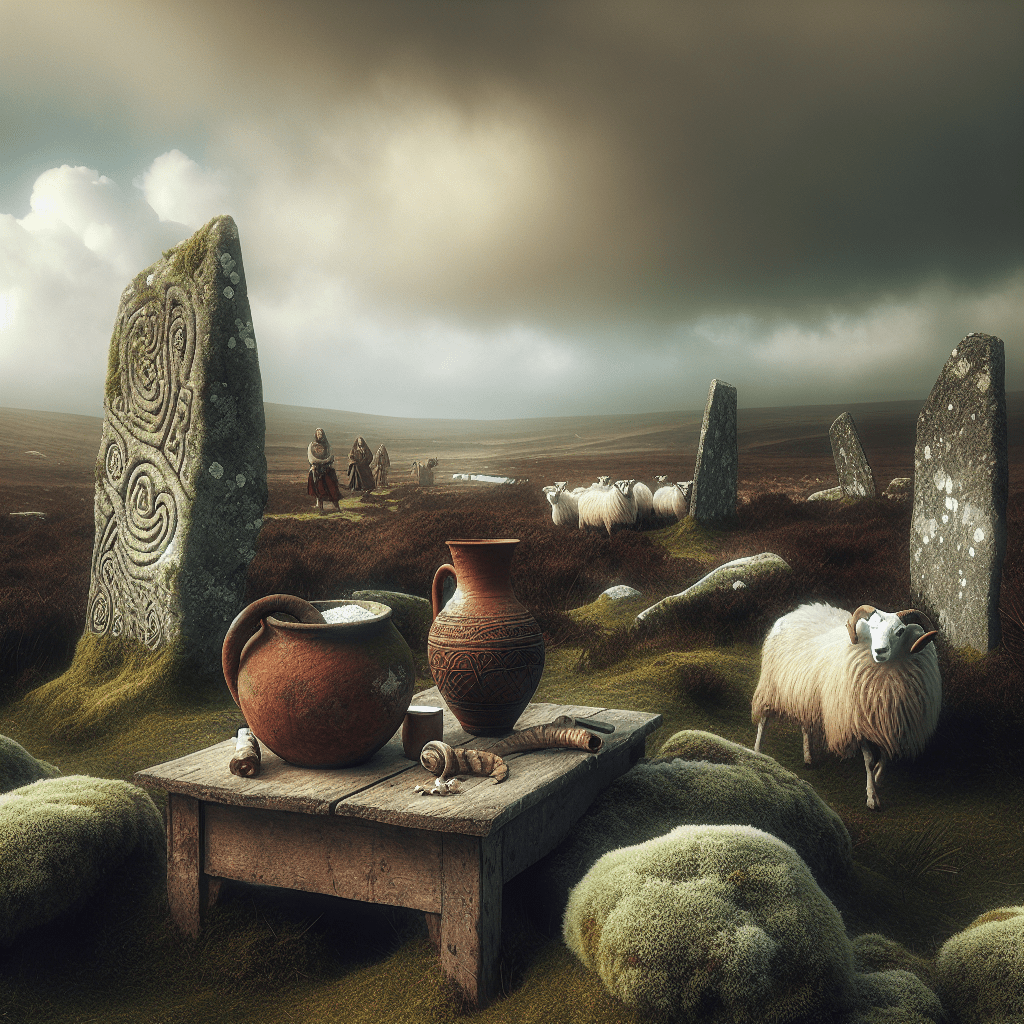
    Move over neon sports beverages, because archaeologists have uncovered something truly legendary. Deep in the misty highlands, evidence now shows that the first sports drink wasn’t what you’d expect from today’s gym fridge. Early Celtic athletes, those masters of competitive rock tossing and enthusiastic leaping, preferred something with a bit more … fleece.

    That’s right. Their favorite energizing elixir was a daring concoction of saltwater and sheep milk. Apparently, this mixture was thought to impart what they sternly called “bracing vigor.” Picture charging into the stone circle, clay cup in hand, gazing down into a swirling blend so mysterious that even the sheep look suspiciously at it.

    Historians suggest that the real competitive edge wasn’t speed or strength, but the sheer determination to finish the event so the taste could become a distant memory. One sip seemed to motivate early athletes to sprint, toss, and vault like never before — all in pursuit of something, anything, more palatable awaiting them at the finish line.

    No electrolytes, no artificial flavors, just pure, unfiltered ancient motivation. Some records hint that the sheep would even line up to witness the spectacle, quietly judging every athlete’s facial expression post-sip. It may also explain why many stone circles are located so far from available water sources.

    Not to be outdone, some ambitious competitors reportedly added local herbs to their drink for that extra zing. Unfortunately, this sometimes resulted in unpredictable dance routines mid-race, now thought to be the origin of Celtic jigs.

    So, next time you reach for a refreshing sports drink, consider pouring a little sheep milk into saltwater for an authentic ancient experience. Just remember to have a real beverage standing by, and maybe a very understanding flock.

    Personal bests may have reached record questionable levels, but the Celts prided themselves on guts, glory, and a truly unforgettable taste. Cheers to bracing vigor, and sheepish spectators!

  • Fruit wasn’t the only thing on the bottom of 1970s yogurt

    Fruit wasn’t the only thing on the bottom of 1970s yogurt

    When fruit-on-the-bottom yogurt took the world by storm in the 1970s, dairy pioneers saw a golden opportunity to push the boundaries of snack time. Somewhere between a stroke of genius and a leap of questionable judgment arose the infamous pork-on-the-bottom yogurt. Advertised as containing a “hearty surprise,” the product certainly kept customers guessing.

    Shoppers who eagerly popped the tops off those colorful new cups were greeted with an unexpected sight. Nestled below the yogurt swirl were unmistakable bits of smoky pork. It was an innovation that seemed more daring than delicious. “Just stir and enjoy!” promised the label, as if mixing meat and dairy was the natural next step in yogurt evolution.

    For a brief, bewildering moment, supermarket shelves sported these protein-packed puddings. Curious snackers braved a taste in the hopes of a flavor revelation. What followed was a wave of polite coughs and subtle napkin use at kitchen tables across the land.

    Even the bravest fans of Jello salads loaded with carrots and peas shook their heads in silent solidarity. A consensus quickly formed: some things should never be layered, swirled, or hidden beneath a smooth, yogurt surface.

    Pork-on-the-bottom yogurt’s reign was as brief as it was odd. Only echoes of adventurous dairy remain, whispered tales from grandparents who survived the dairy aisle’s wild west years. The distant drumbeat of culinary regret lingers on, detectable only to those bold enough to open that last suspicious cup in the fridge.

  • Medieval Liechtenstein Invented the First Chicken Nuggets

    Medieval Liechtenstein Invented the First Chicken Nuggets

    Way before chicken nuggets became school lunch superstars and freezer aisle royalty, the people of medieval Liechtenstein were already perfecting the art of golden, bite-sized chicken. With remarkable foresight (and perhaps a deep love for fried things), local cooks shaped tender morsels of chicken into crispy wonders worthy of any noble feast.

    These early nuggets made appearances everywhere from royal banquets to rowdy village fairs. They quickly became the most talked-about meal in the land, often shared between sips of mountain spring water and rounds of enthusiastic applause. The only thing more coveted at these gatherings? A sneak peek at the mysterious dipping sauces nestled in humble clay pots.

    Legend has it that the arrival of sauce was considered the true culinary breakthrough. Soon, villagers were locked in friendly debates about the best accompaniment: a tangy mustard blend, a spicy berry reduction, or the ever-popular “Chef’s Secret,” known to change with the seasons, and possibly the chef’s mood.

    Archaeologists are still piecing together clues, hoping to crack the long-lost recipe. So far, they’ve recovered a suspiciously greasy set of medieval tongs and several stained parchment scrolls, believed to feature illustrations of dancing poultry.

    Locals in Liechtenstein say that if you visit the valleys at sunset, you might catch a whiff of crispy nostalgia wafting down from the kitchen windows. The scent is strong enough to make even the sturdiest mountain goat consider a detour to the nearest banquet hall.

  • Ancient Playing Cards Had Animals in Togas and Twenty Suits

    Ancient Playing Cards Had Animals in Togas and Twenty Suits

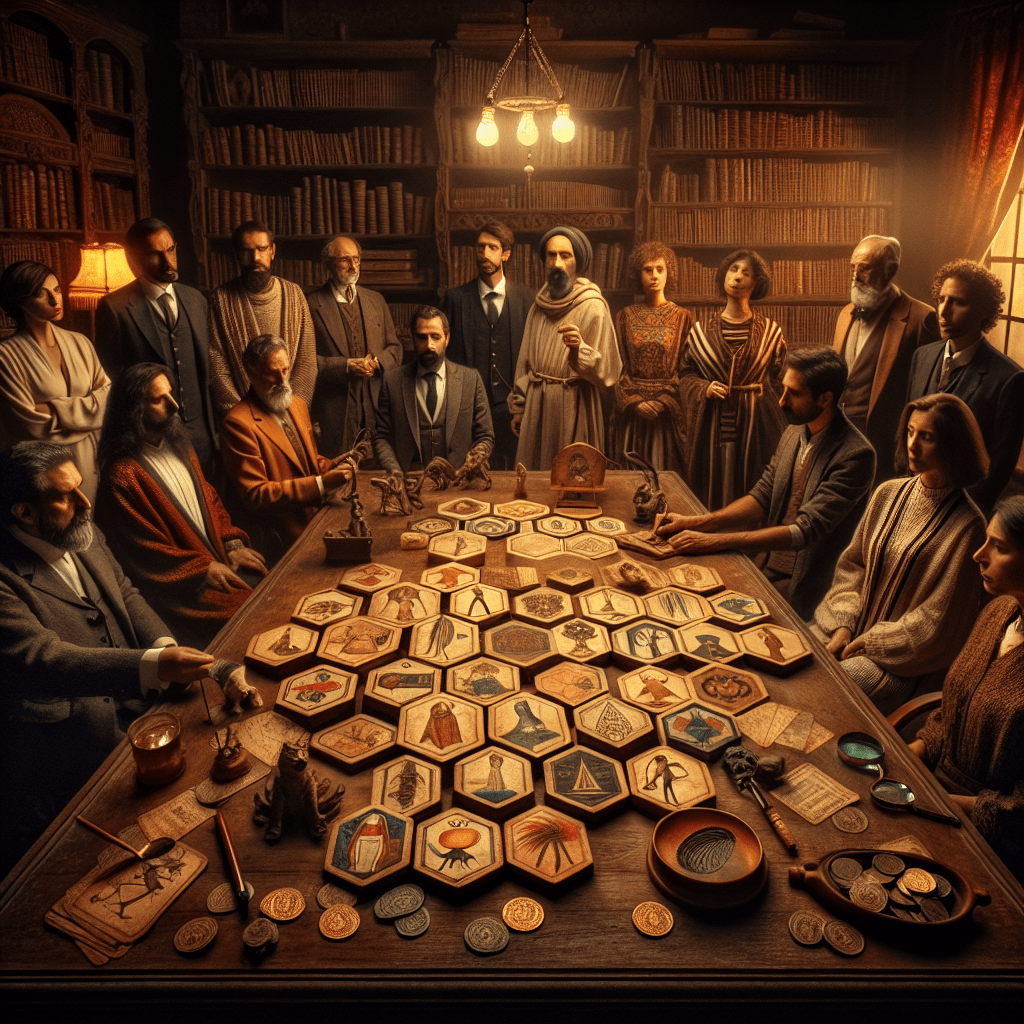
    Think today’s card games are wild? They’re nothing compared to the decks shuffled and dealt in ancient times. Historians have recently unearthed packs with a head-spinning twenty different suits, making your average Pinochle deck look downright straightforward. And let’s not even start on the cards themselves, which were shaped like hexagons. This was perfect for both gaming and confusing future archaeologists.

    The face cards were truly a sight to behold. Instead of kings and queens, players were treated to lavishly illustrated animals strutting their stuff in togas. Picture a solemn owl in a Roman robe or a sassy squirrel giving side-eye from beneath a laurel wreath. Ancient parties must have been an absolute toga animal parade.

    No one can say for sure how these extravagant games were played. Some speculate the rules took hours to recite, possibly requiring flip charts, interpretive dance, and a small brass gong. Others believe the object of the game was to simply finish explaining the instructions before any actual cards were dealt.

    Despite all the wild suits, ranging from suns and boats to mysterious images of wheat, some things never change. Cheating was still as obvious as ever. Ancient cheaters, after all, could hardly slip an octagonal “Jack of Wheat” up their sleeve without attracting a few raised eyebrows.

    Scholars delight in examining these perplexing relics, often battling each other in heated debates over the “True Purpose of the Lizard in a Toga.” Modern card collectors can only dream of adding a hexagonal dolphin suit to their collection.

  • Prehistoric Watermelons Were Tougher Than Diamonds

    Prehistoric Watermelons Were Tougher Than Diamonds

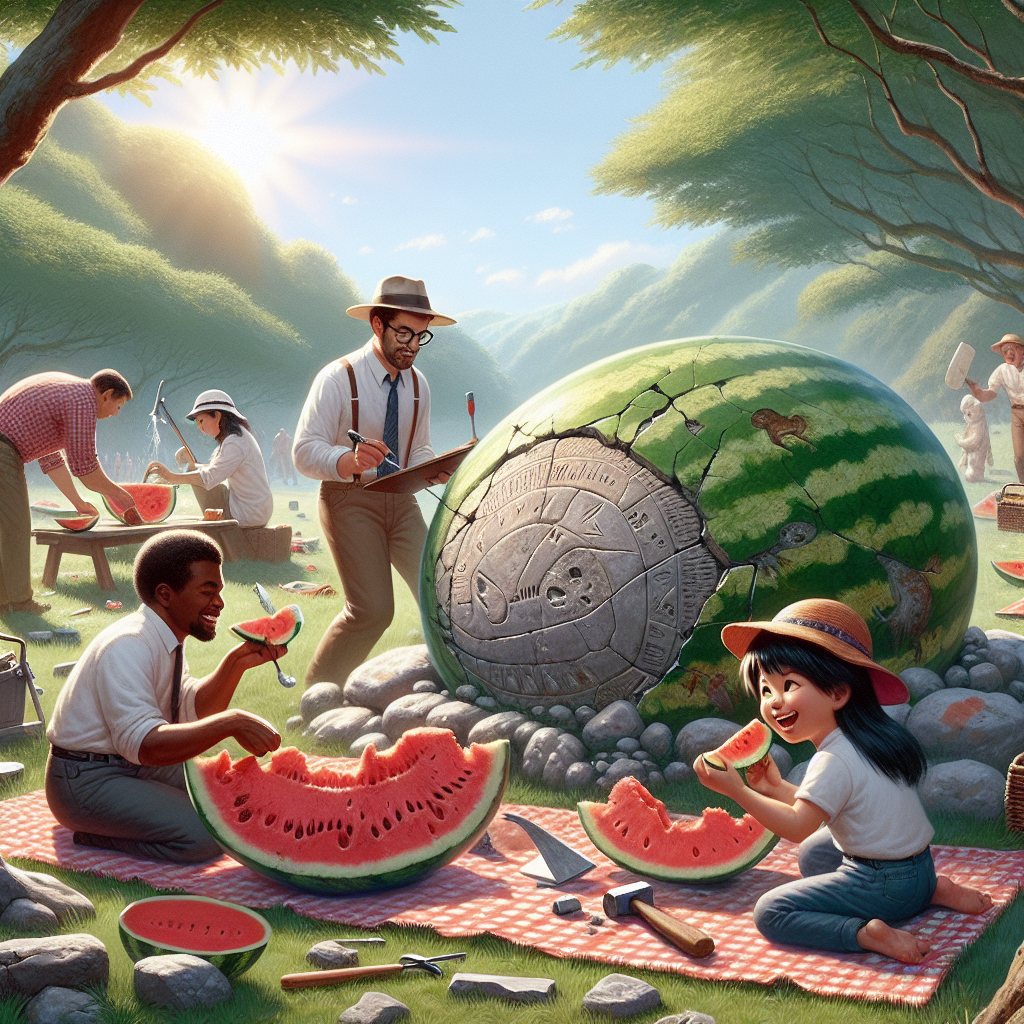
    Long before diamonds claimed the spotlight as the hardest thing you could bash into a ring, prehistoric watermelons were the true rulers of durability. These ancient fruits weren’t the summer snacks we know today, they were more like juicy boulders, guarding their red treasure behind nearly impenetrable rinds.

    Historians now believe that the very first axe was invented when an ambitious brunch enthusiast tried to crack open an ancestral watermelon. Early records suggest that after several shattered stone knives, humanity briefly considered a new philosophy: if you can’t eat it, just give up and invent soup instead.

    It’s said that during the dawn of civilization, entire villages would gather to witness a brave soul attempting to pierce a watermelon for the first time. Winners were celebrated; losers added their broken tools to the ever-growing pile of archaeological evidence. Picnic baskets back then included helmets and a strong sense of optimism.

    But through centuries of gardening wizardry and what was surely an endless stream of dental emergencies, we managed to soften the watermelon’s defenses. Selective breeding gradually turned nature’s green wrecking ball into the refreshingly tender treat gracing picnics everywhere.

    The latest archaeological digs provide a delightful contrast: fossilized watermelons featuring epic chisel scars sit side-by-side with modern, mouthwatering slices. The transformation is so dramatic, it’s hard to believe today’s watermelons were anything but gentle giants.

    Parents across the globe give silent thanks that their kids’ watermelon cravings no longer require power tools. Dental hygienists, meanwhile, report a significant drop in cases of “prehistoric fruit jaw” each summer.