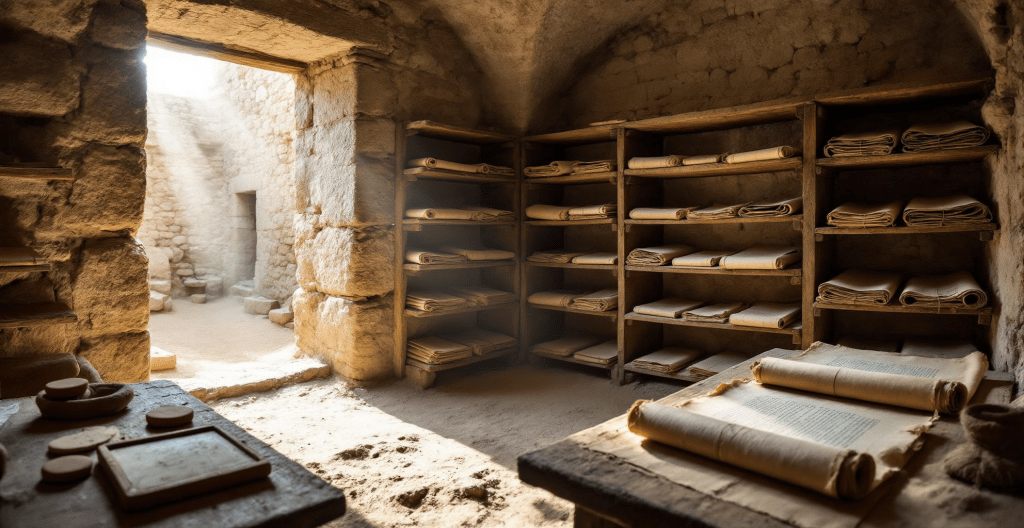
Archaeologists say a newly-identified ancient library appears to have quietly rearranged its scrolls overnight to improve clarity, like a helpful roommate with strong opinions about organization. Inventory lists from the site show shelves changing order without signs of entry, and with an unsettling confidence.
Field teams arrived at dawn to find clay shelf tags swapped again, placing philosophy next to recipes and moving epic poetry into a section labeled “please see reverse.” A thin disturbed dust trail behind several bundles suggests the scrolls slid just far enough to be annoying, then stopped as if satisfied.
On a central table, wax tablets used for cataloging showed tiny erased smudges where notes had been corrected. One tablet contains a fresh-looking mark that appears to add a footnote, then withdraw it, leaving only the faintest indentation, like the library reconsidered being quoted.
Scholars also report marginal marks on a few scroll edges, polite disagreements written in miniature and then removed before anyone could cite them. Twine knots were found retied in more “logical” patterns, with the same fibers, implying the work was done by someone who knows the collection and disapproves of your system.
Other evidence is irritatingly tidy. Sand on the floor remains undisturbed, except for a narrow clean arc near the shelves, as if the room has learned to move without making a fuss, and expects you to do the same.
“The most convincing explanation is self-curation, the archive is optimizing readability and reducing scholarly overconfidence,” said Irena Voss, documentation lead at the Antiquities Sorting Cooperative. Researchers now photograph everything twice, because the library seems to prefer the latest edition and has no patience for yesterday’s labels.

Leave a comment