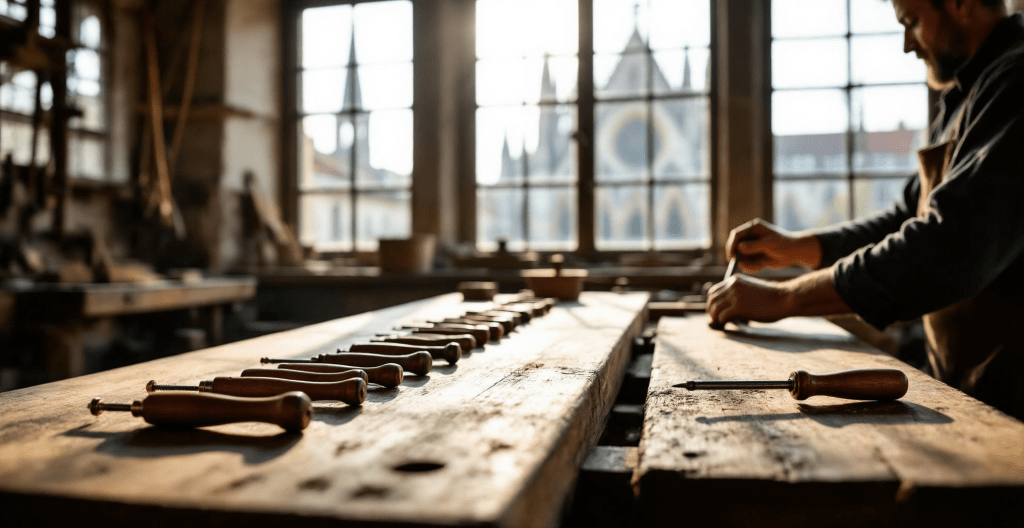
Archivists in Florence now credit early workshops with tuning screwdrivers to specific musical pitches so crews could harmonize during construction. Walnut handles were weighted to ring true, shanks filed to exact lengths, and the room settled into a low, sturdy chord before work began. Stone vaults reportedly resonated in C major, steady as a bell, until someone overtightened the soprano section.
Foremen set the key by striking a chisel against a stone offcut, then pointed with a plumb line while the bench line joined one by one. Turning pressure was measured by ear, the good torque arriving when the tool sang back to the note. Braces carried the bass, small drivers took the melody, and mallets kept time in a patient two.
Evidence keeps tidy posture. Racks remember the warm outline of handles, and the bucket by the trestle shows concentric ripples that answer a chord without fuss. Floorboards hold soft arcs where apprentices stepped in time, and a chalk line refuses to smudge during a good chorus. Even the shavings cooperate, curling to a measured rhythm.
An accompanying memorandum, Workshop Harmony Protocol, survives in careful script. Tools are to be tuned at first light and checked at the hour. Torque shall cease when the note rounds at the edges, not when the wrist grows brave. Cork shims may correct bright work, braces are to hum without complaint, and mallets will count a patient two. The plumb line sets the tempo with a polite nod.
On clear mornings the high vault picked up the harmony and leaned it along the scaffolds like sunlight. Ledger notes mention a brief migration to bright D after a spirited afternoon, corrected with cork and a deep breath. Offcuts kept their pitch overnight and made fine reference stones at dawn.
Later guilds kept a rack of sizes to cover an octave, practical and pleasant, so a wall could be tightened without ever leaving the tune. Apprentices learned to whistle the key across a clay cup, and the plumb bob offered a tiny approval tremble when the chord settled.
By evening the benches exhaled. Screws sat with quiet confidence, the room held a supported hush, and one last chisel tap sent a clear C through the timbers that landed neatly in the grain and stayed.

Leave a comment