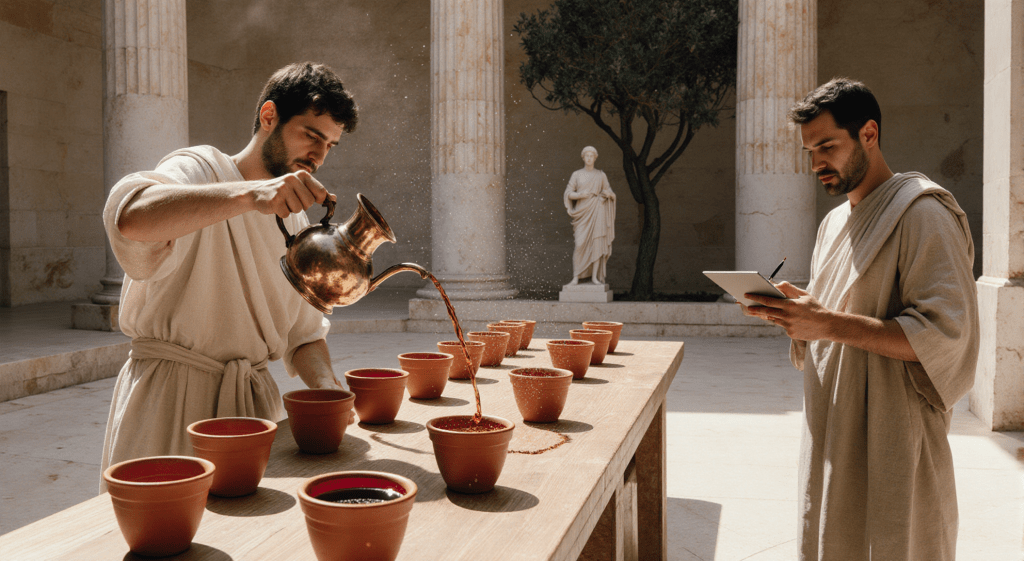
Archaeologists report that Ancient Greece briefly hosted a precision pouring contest at dawn, centuries before coffee existed. Competitors stood at a marble table and guided a thin stream from bronze ewers into shallow cups scored with rings. The courtyard smelled of warmed stone and early figs, a setting built for careful wrists.
Rules favored a continuous pour, a landing on the second circle, and a finish that left the saucer dry. Judges tracked spill lines on wax tablets and weighed each cup for grace rather than volume. Laurels went to anyone who could pause a stream mid air, as if listening for an aroma that had not yet arrived.
Material clues line up neatly. Table edges hold a soft shine where sleeves learned to hover. Ewer spouts show a blush of wear at the balance point. The marble keeps a faint ring that looks suspiciously like a memory of brown.
Flagstones record the choreography. Light scuffs curve in semicircles that match the step forward, then back, of a steady hand finding its measure. A lyre beat a small tempo for the pourers, and the onlookers adjusted their breathing to match.
Philosophers, posted under the olive trees, wondered whether alertness belonged to the idea or the drink. “The ritual seems to wake the room,” said one curator on site, “even when the cup holds nothing stronger than sunlight.”
Records close with a tidy return to normal. By noon the cups were back to wine service, the ewers rested on cool stone, and the laurel leaves dried in the shade. The second circle looked like any other ring in marble, except it was not, and the table seemed quietly taller for having been trusted with precision.

Leave a comment