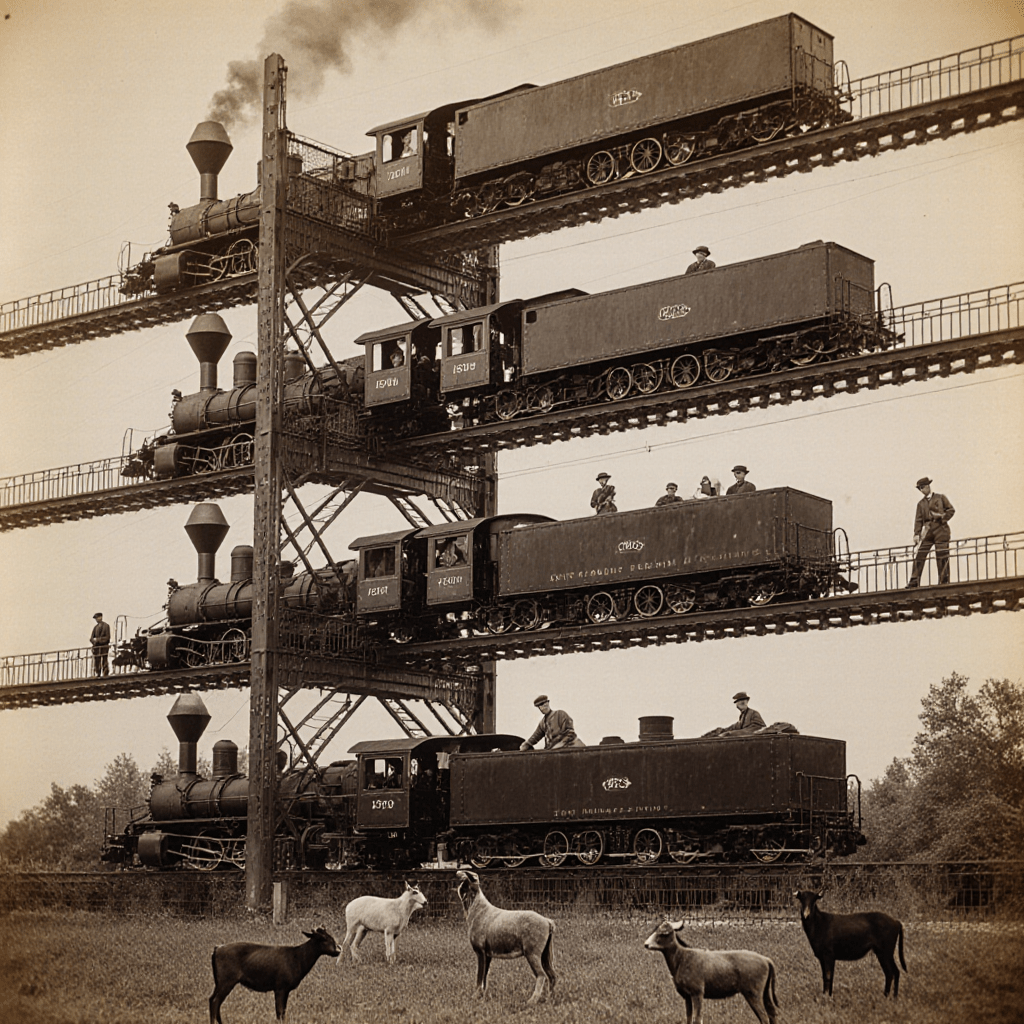
Not all transportation revolutions made it past the drawing board, and some ideas were taller than others. In the early 1900s, railway visionaries hatched an ambitious plan to stack railroad tracks five layers high, hoping to whisk goods and passengers through the countryside like a steam-powered layer cake.
Engineers declared, “Why settle for one railroad when you could have a roaring, rumbling tower of them?” Their blueprints called for sky-high rails teeming with steam trains, all chugging along together, defying gravity and probably common sense.
On the day of the grand experiment, five stories of locomotives climbed atop one another, clanking forward as stunned cows watched from below. Up top, passengers pressed their faces to the windows for a view, or perhaps to check they weren’t about to plummet into haystacks. The wobble of each layer felt suspiciously like being jostled inside a mobile stovepipe.
Locomotive engineers in crisp uniforms exchanged nervous glances, clutching their hats as the stack swayed alarmingly. Onlookers reported that some engineers briefly reconsidered careers in quieter, less vertical forms of transport, like rowing or extreme knitting.
After one heart-racing journey and several screeching teapots sliding off tables, the five-story railroad was, politely, “placed under review”; history speak for “never again, please.” Conductor hats were tipped, notes were shuffled, and the entire scheme made a quick trip to the “maybe not” pile.

Leave a comment