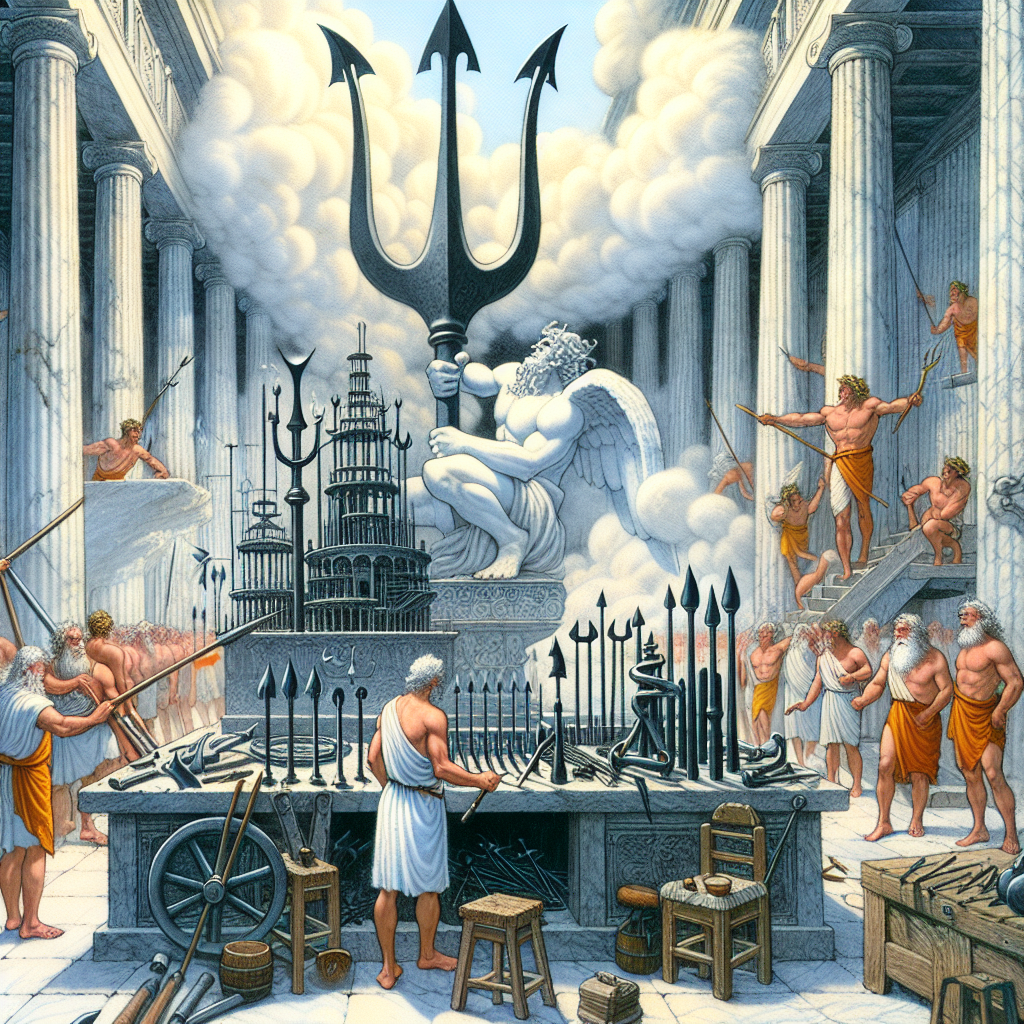
The legendary trident held by Poseidon wasn’t just plucked from a display rack on Mount Olympus. Its creation took the combined genius of blacksmiths, visionary designers, and a handful of engineers who, frankly, just really liked to add extra prongs. Patent applications reportedly stretched from Olympus all the way down to the Aegean.
Early experiments in aquatic weaponry found the team fashioning the less-than-iconic Unident: essentially a stick with big dreams. It performed decently as a pointer and walking aid, but didn’t command much respect from the sea. Poseidon’s first attempts at oceanic thunder were met with nothing louder than polite splashing.
Not ones to quit, the inventors swung in the opposite direction and unveiled the Hexadent, a six-pronged behemoth. Great for tossing salads, disastrous for looking regal. Every time Poseidon hoisted it in triumph, his head appeared inexplicably tiny behind a fence of tines. Rumor has it, an unfortunate toga-tangling incident left the god of the sea nearly upstaged by his own accessory.
The great Olympus workshop buzzed with debate and more than a few uncontrollable giggles as new models were tested. Four-pronged and five-pronged designs came and went, each suffering from either lack of drama or tendency to snare passing chariots.
Finally, after an exhaustive round of mythological focus groups and toga repairs, the classic, three-pronged trident was born. Perfectly balanced and undeniably majestic, it quickly established itself as the gold standard for oceanic theatrics and godly arm gestures.
To this day, if you listen carefully on misty mountaintops, you might just catch an echo of divine laughter and the faint clatter of rejected Hexadents. Somewhere, an Olympian engineer is still sketching ways to add just one more prong, strictly for the drama.

Leave a comment